
INTRODUCTION: When Messaging App Go Rogue
In this vast digital landscape of the internet, Telegram has risen to dominance as a platform for its security and privacy features. However, behind the scenes there exists a hidden economy that is booming on stealing and trading valuable digital metadata. Telegram is no longer just a messaging app—a part of it has mutated into a hub for cybercrime logistics, especially for the circulation of stealer logs. Cybercriminals have been using Telegram to buy and sell "stealer logs," which are essentially logs containing stolen credentials and sensitive information. This illicit activity has created clouds of chaos within the cybersecurity realm, posing a significant threat to individuals and organizations alike. These logs, often harvested from infected systems via information-stealer malware popularly known as infostealers like Redline, Raccoon, or Lumma, are fueling the black-market economy of infostealer logs where data is the currency— and Telegram’s “clouds of logs” are the delivery trucks. This illicit black market has created chaos within the cybersecurity domain, posing a significant threat to individuals and organizations alike. This blog dives into the hidden economy of stealer logs and its circulation via Telegram channels and explores the implications of this evolving cyber threat.
Unlike traditional dark web marketplaces that utilize onion routing through the Tor network and complex escrow services, Telegram has become a faster and more straightforward alternative for cybercriminals. It provides an always-on, frictionless logistics platform that allows for the anonymous bulk sharing of stolen data, effectively bypassing many of the challenges typically associated with dark web marketplaces.
Today, both Clearnet and Dark Web forums primarily serve as channels to funnel users to Telegram channels. They often post bait links or short URLs that lead to Telegram "clouds of logs," which are nothing but the various Telegram channels with the cloud nomenclature. Large volumes of compromised data from the stealer logs are uploaded on a daily basis. These channels often contain compressed files that can be gigabytes in size for a single file drop, available for trade or for free.
What makes Telegram particularly dangerous is its dual nature: while it appears innocent and mainstream on the surface to reach the mass audience, beneath that layer lies a weaponized ecosystem of stealer logs quietly fueling the economy of credential theft and data breaches of many companies. With our custom Telegram Analytics Tool, we can now observe this cluster of Telegram channels hidden in the black market at scale ,tracking everything from log volumes and file types to drop patterns exposing a threat landscape that's no longer buried deep in the dark web but hiding in plain sight.

These channels often include a backup link, support channel, and admin panel for further cases or to preserve it after a channel ban. The compressed files shown in the image are the clusters of logs, which sometimes may contain up to thousands of stealer logs in a single archive file. Logs shared here often include logs from other cloud channels, consolidating the hidden economy flow. Free and paid packets like this archive show the raw trade of digital identities via info-stealers and distributed to a mass audience, which makes the user’s system vulnerable to cyberattacks whose data had been leaked on those stealer log files.
Why are Stealer Logs so Dangerous?
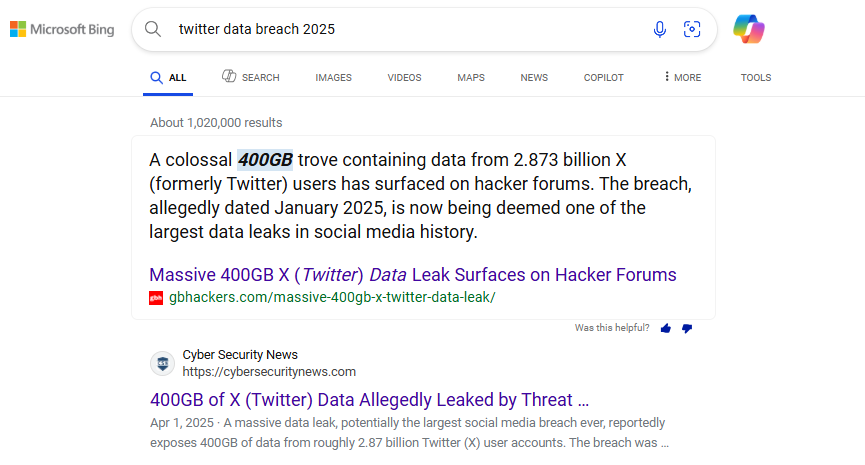
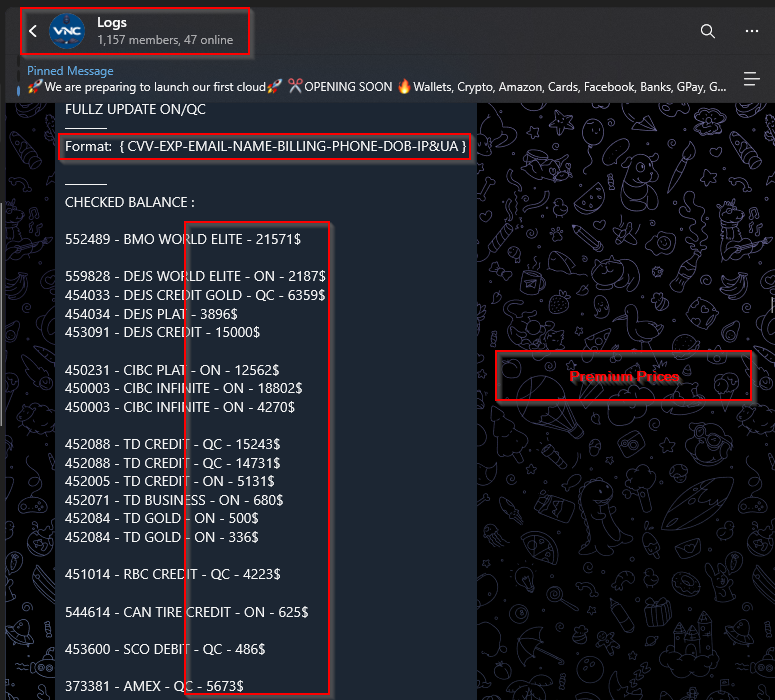
Unlike surface-level credential leaks, such as one of the hyped breaches where a threat actor claimed to have scraped 400GB of Twitter user data—including usernames, emails, login timestamps, and follower metrics this dump lacked passwords or actionable credentials. While it generated buzz due to its bulk volume and OSINT rich value, it paled in comparison to the operational cyber threat posed by stealer logs. These logs hand over the keys: valid credentials, session tokens, browser fingerprints, and even autofill data, enabling attackers to bypass security with precision. In many cases, they go further capturing credit card details or CVV dumps, which command premium prices in the Telegram channels. This context-rich data fuels credential stuffing, identity fraud, and lateral movement within networks, making stealer logs the true currency of Telegram’s “Clouds of Chaos.” One such example is illustrated in the Telegram snapshot below:
Stealer Logs: Anatomy of a Data Heist
In the cybercrime domain, stealer logs are the pinnacle of exfiltration into the individual’s or organization’s system. Users may be infected using different techniques, such as downloading cracked software, downloading files from unsafe websites, phishing links, or utilizing pirated activation software. Such techniques tend to loosen security, potentially leaving devices open to infostealer malware that steals sensitive information silently. The data obtained from infected devices is typically bought, accessed, and utilized by threat actors to compromise systems, steal money, or even evade ransomware attacks on organizations.
What’s Inside a Stealer Log?
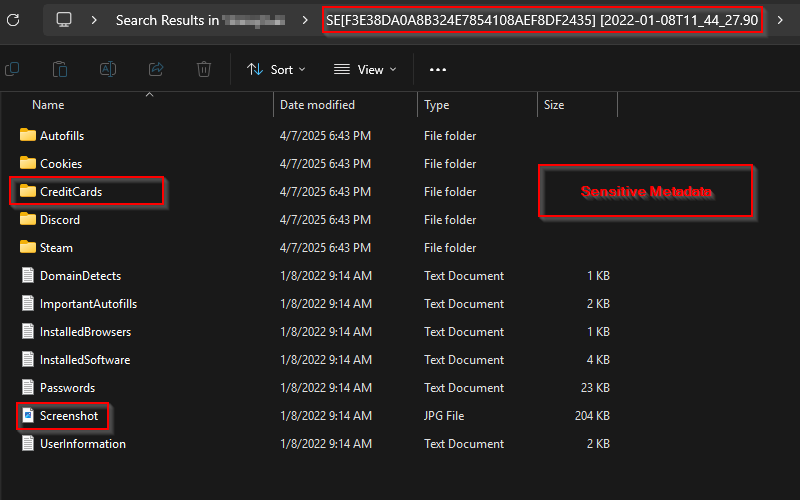
This screenshot captures the internal structure of a stealer log folder, likely exfiltrated by infostealer malware and shared via the Telegram messaging app. The folder name typically includes the user’s system’s hash and a timestamp of exfiltration.
Here each subfolder represents its own category of harvested data, like
- Autofills : Contains browser-saved personal details like name, emails, and phone numbers
- Device system info, including hostname, IP address, OS version, and installed antivirus, under UserInformation.txt
- Cookies : Active session cookies are used to bypass logins and 2FA.
- Passwords : The core asset cleartext or hash for user login passwords for websites, email, SaaS platforms, VPNs, streaming services, etc. Later this is parsed to generate combolists. I’ll discuss about combolists in another blog coming soon.
- Files were extracted from the infected device.
- Saved credentials from the browsers like Chrome or Microsoft Edge
- Steam / DomainDetects : Steam targets gaming accounts, while “DomainDetects” flags access to corporate or high-value environments.
- Crypto wallet data often stored in .dat or .ldb formats
- Grabbed files or screenshots, sometimes from specific directories (Desktop, Documents, etc.)
- Credit cards, in this example it’s there, but they are rare.
Drilling into one of these folders reveals the complete digital footprint of a victim. The above snapshot showcases the amount of variance of data that is present inside a single folder, which is related to a single victim, like Passwords.txt, InstalledBrowsers.txt, and cookies that expose saved logins, session data, and browser usage. System metadata such as IP address, antivirus product, HWD info, and OS version are often under UserInformation.txt. Some logs go even further, capturing screenshots, files, or stolen credit card files handling over not just the system metadata, but a full visual and financial snapshot of the victim’s digital life.
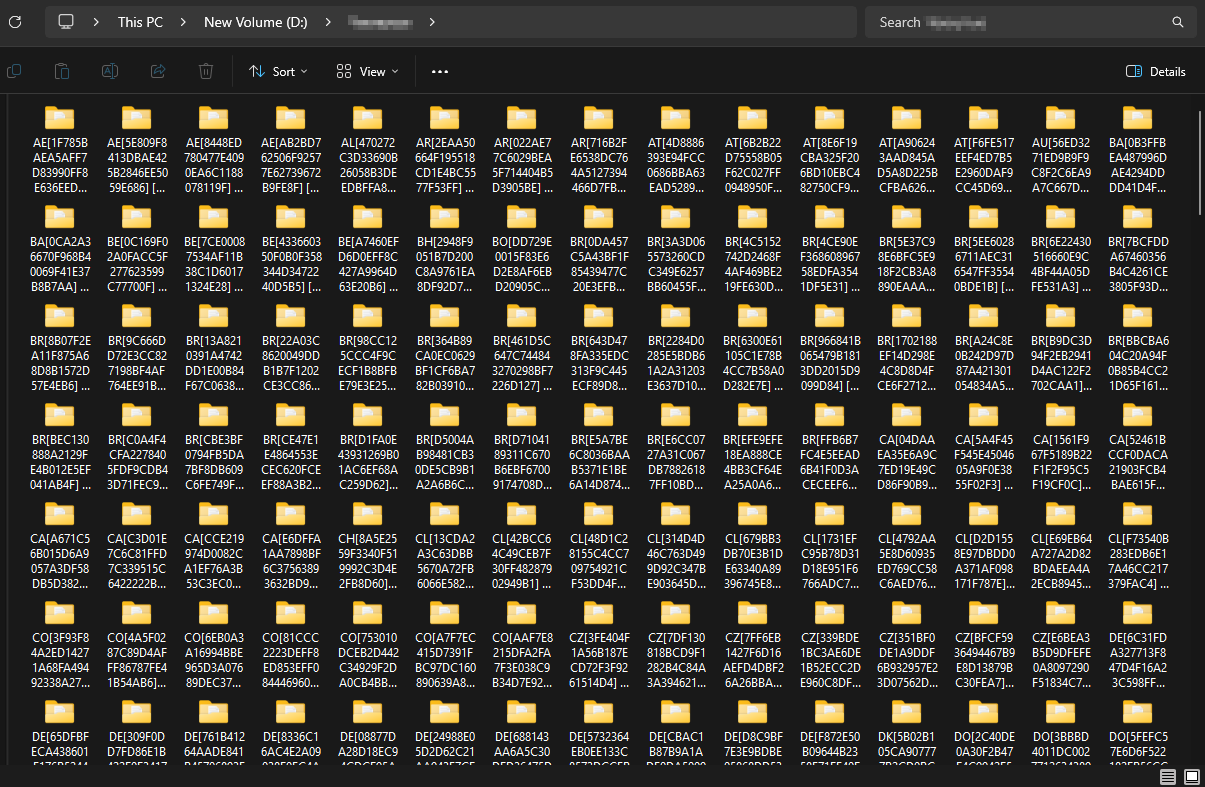
Above is the infected victim data. For this example, we encountered 614 uniquely identified folders, which are typically organized in a consistent format: COUNTRY [<VICTIM DATA>] [<Timestamp>], as I mentioned earlier. Every folder in the screenshot above represents one unique victim, where the Ex filtered data for each system is stored. These logs normally contain hundreds, if not sometimes thousands, of unique victim data points. This consistent pattern enables threat actors to easily organize and track individual logs among the millions of logs for resale, parsing, carding, and other types of credential theft. The infostealer organizations that are popular in this economy are Redline, Raccoon, or Lumma logs. The bulk volume in a single dump illustrates the extent to which this data theft pipeline has been industrialized.
Quantifying the Chaos: Telegram Analytics at Work
To truly understand the vastness of Telegram’s role in the stealer log economy, Techowl ran our Telegram Analytics Tool across 233 active channels. The results were staggering.
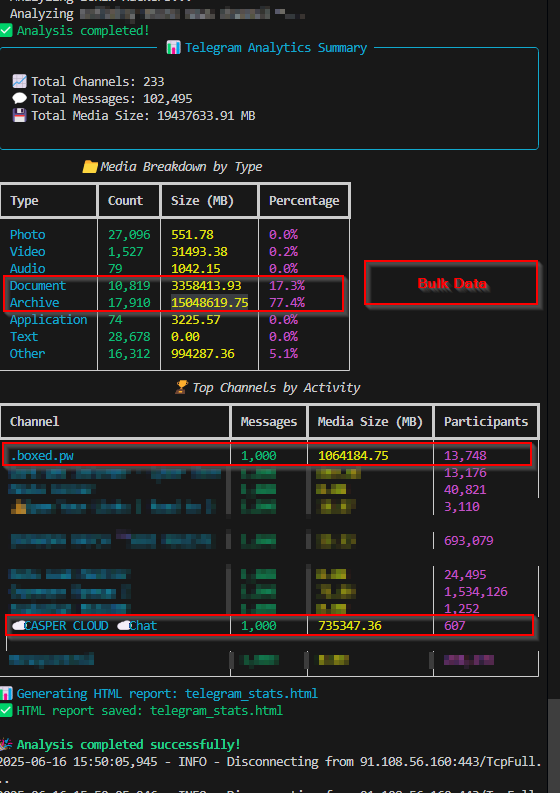
Telegram Analytics Report: Over 102,000 messages analyzed across 233 channels ,19.4 TB of total media, with 77% being archive files linked to stealer logs.
Key findings:
- 102,495 messages across the channels analyzed
- 19,437,633.91 MB (~19.4 TB) of total media shared
- 77.4% of all media volume came from .zip, .rar, or .7z archives indicating stealer logs were the dominant payload
- Channels like .boxed.pw alone contributed over 10 TB of archive data
- Many other channels posted gigabytes of logs per day, both publicly and via bot automation
These figures reinforce what we've seen qualitatively: Telegram isn't just a side-channel for cybercriminals ,it's the core infrastructure supporting global data theft.
Dominance by Malware Family
The analysis also broke down the most prevalent infostealers across the observed Telegram channels. Unsurprisingly, the most dominant names reflect the same families consistently seen in enterprise breach telemetry.
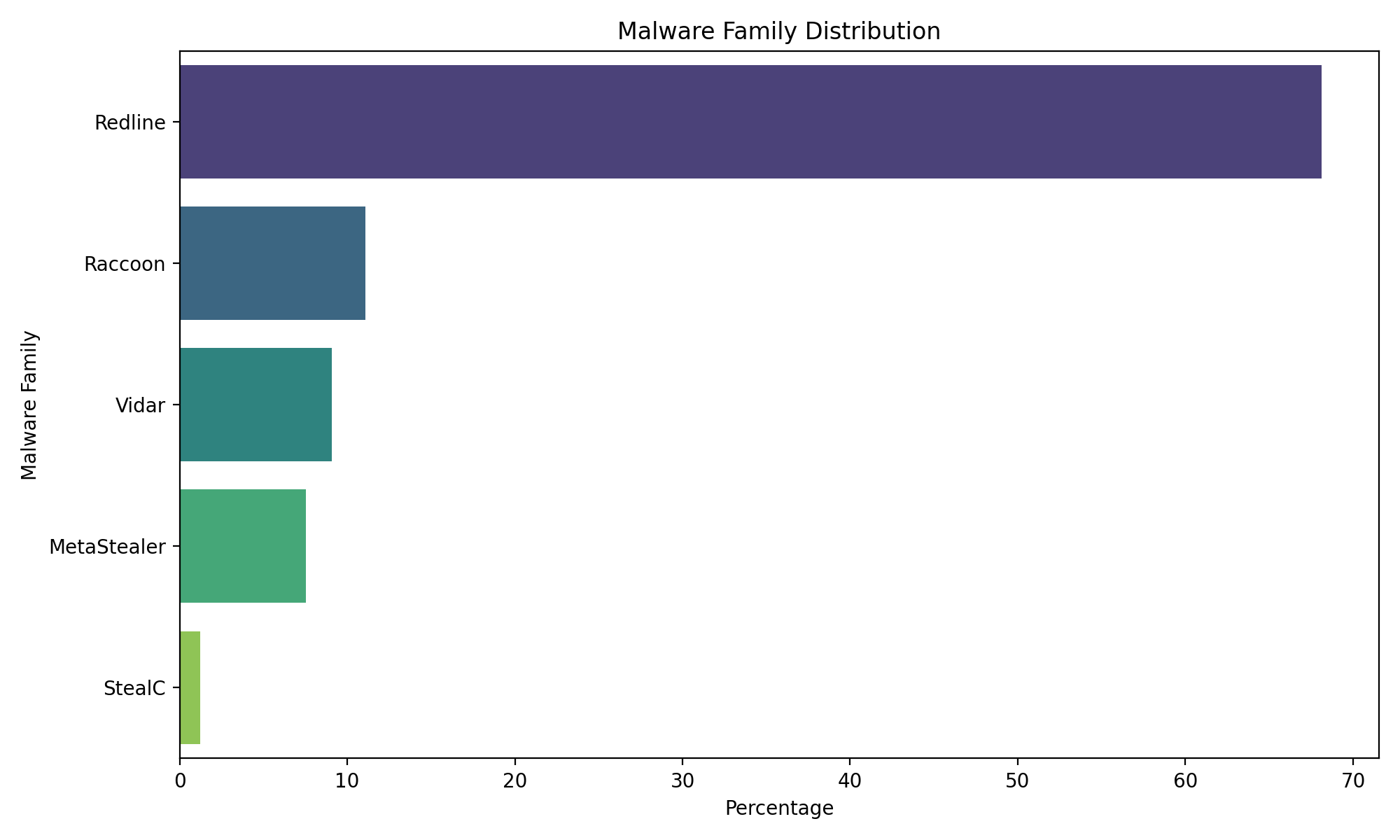
Distribution by Stealer Family:
- Redline: 68.14%
- Raccoon: 11.07%
- Vidar: 9.10%
- MetaStealer: 7.54%
- StealC: 1.22%
These malware families are responsible for the majority of logs flooding Telegram, and their presence directly correlates with the high archive volume we observed in our scan.
Together, these analytics confirm one thing beyond doubt: Telegram isn't just hosting the stealer log economy ,it's powering it.
The Lifecycle: From Infostealer Developer to Infected Victim via Telegram
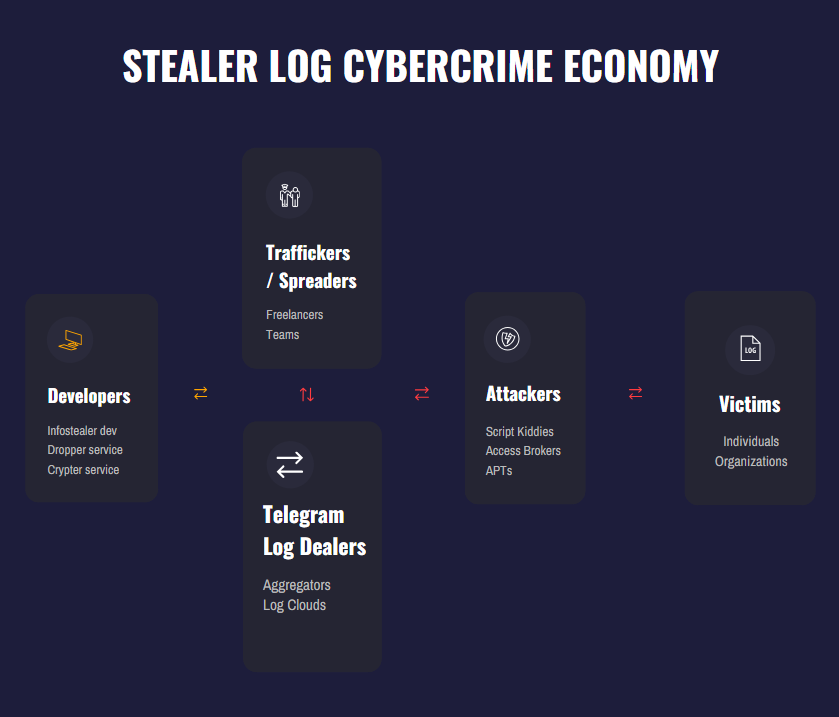
From the moment an infostealer malware is coded by a developer, it begins a pipeline that almost always routes through Telegram “clouds of logs” at some point. Spreaders and traffickers push the malware into the wild—often using cracked software or malvertising—while log dealers and aggregators use Telegram “clouds of logs” to collect and sort the harvested stolen data.
These logs are then bought, shared, or resold by attackers ranging from script kiddies to ransomware operators who exploit them for credential stuffing, financial fraud, or corporate access. All of this happens within Telegram’s infrastructure, in near real-time, across hundreds of channels. Telegram acts as the central nervous system, connecting each threat actor in this cybercrime hidden economy from malware developers to final-stage victim exploitation and accelerating every stage of the compromise cycle.
From creation to compromise to resale, Telegram operationalizes the entire lifecycle of infostealer logs, acting as the hidden backbone of today’s credential theft economy.
-
Infection
The lifecycle begins when a victim unknowingly executes a malicious file often disguised as cracked software, a game cheat, or a spoofed attachment.
-
Harvesting
The infostealer silently scans the system and harvests sensitive data: saved browser credentials, session cookies, cryptocurrency wallets, autofill entries, and more.
-
Packaging
The stolen data is organized into a structured folder archive. These typically include metadata such as below as I earlier discussed:
- IP address
- Timestamp
- Country code
- System/user identifiers usually by hash
- Targeted applications (e.g., MetaMask, Steam)
-
Exfiltration
The log archive is transmitted to the attacker’s server, usually via Telegram bot APIs or C2 server of threat actor then through Telegram bot APIs. This ensures fast delivery and avoids complex infrastructure dependencies.
-
Distribution
Once collected, logs are:
- Bundled with others into massive
.zipor.rararchives - Uploaded to Telegram “clouds of logs”
- Sold or shared through automated bots and VIP groups
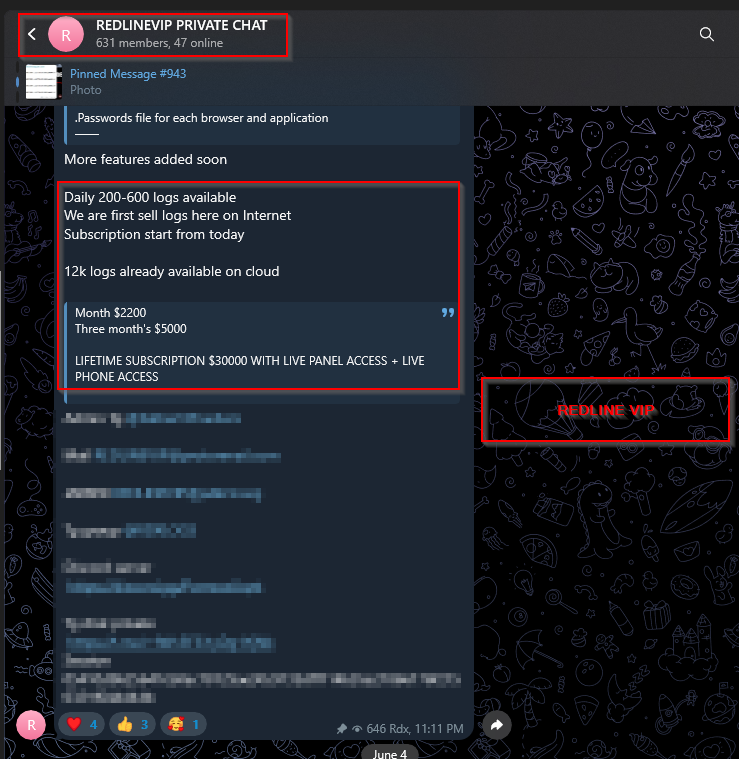
One such example of VIP group is captured above.
- Bundled with others into massive
Dark Web Insight: Telegram is the New Dark Web, But Faster
As the traditional dark web markets suffer from increasing takedowns, infiltration, and legal scrutiny. Telegram has now emerged as the new dark web in plain sight for speed, anonymity, and scale. What began as a privacy-oriented messenger turned into a command center for cybercrime as a fully operational underground logistics platform, enabling the bulk sharing and trade of stealer logs with just a few steps.
Telegram offers everything that a typical threat actor needs anonymity, bulk file uploads, instant global reach, and bot integrations for a subscription-based operational model. Unlike the darknet marketplaces like breachforum alternatives: darkforums[.]st, bhcforums[.]cc (after the takedown of breachforms last month this type of mirror forums pop up) and Russian market which require invites, captchas, and dark web access, But Telegram channels like .boxed[.]pw, DAISY CLOUD, and Moon Cloud operate with zero friction: no registration, no logins, just raw stealer logs delivered directly to thousands of users daily. These aren't static leaks either they’re live payloads, exfiltrated through bots, reposted across clouds, and parsed into ULPs for sale in near real time, Telegram removes friction entirely making this hidden cyber economy not only accessible but also streamlined.
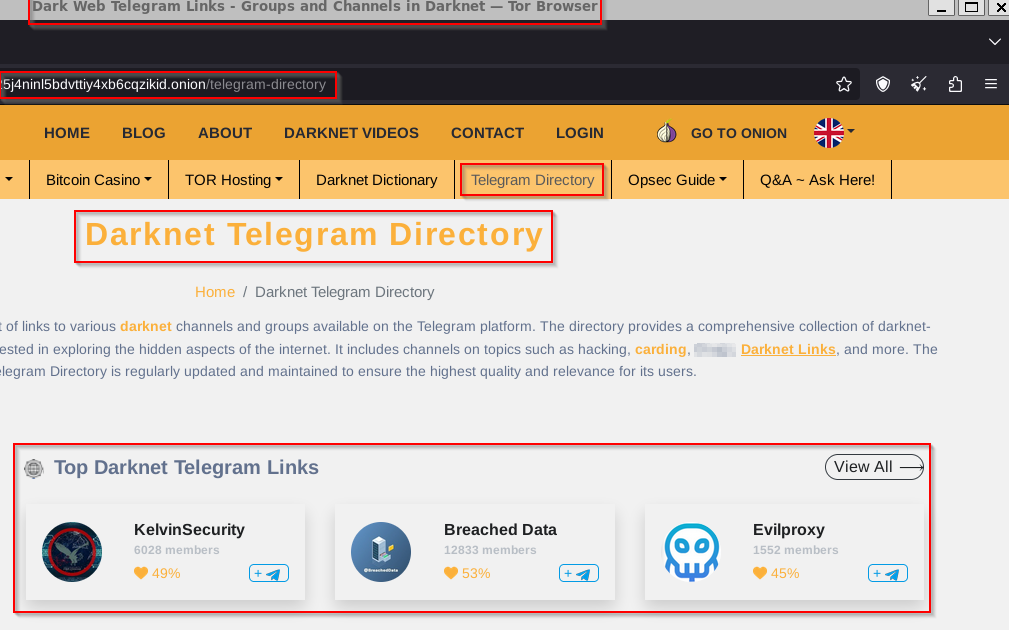
The above image from a .onion directory highlights how Telegram channels are now indexed and promoted directly from dark web marketplaces. With links like “KelvinSecurity” and “Breached Data” here funneling their channels boasting thousands of members, it’s evident that Telegram has smartly replaced slow-loading forums and escrow-driven marketplaces for more digital exposure.
Final Thoughts:
Telegram has fundamentally changed the way credential data is distributed redefining its supply chain model like a digital kingpin, turning raw logs into a scalable, always-on supply chain for cybercrime.
Whether it's a lone script kiddie executing cybercrime from a dorm or a sophisticated ransomware gang purchasing corporate credentials, there's a good chance their operation begins or ends on a Telegram clouds. For defenders serious about staying ahead of modern threat actors, Telegram monitoring is no longer optional but essential.
As stealer logs ignite the underground markets, Telegram remains their wildfire. The faster we map this clouded economy, the better we defend against it. Start watching where they whisperbefore your credentials become the next post.


