Introduction
What happens when a third-party vendor becomes the entry point to a company's data exposure? And how much data can an organisation truly protect when part of its digital ecosystem sits outside its direct control?
On 22 October 2026, the cyber extortion group Everest reportedly claimed to have stolen 590 GB of PwC-related data. A day later, PwC confirmed that it was aware of a cybersecurity incident involving a third-party vendor site used to host employee learning records. According to Reuters' report published on 23 October 2026, PwC stated that the affected site did not house client data, sensitive personal data or financial information. The company also said that the incident did not affect its network or operations.
However, the reported 590 GB figure and the contents of the allegedly stolen data were not confirmed by PwC. The vendor's identity, the technical cause and the full extent of the incident also remained undisclosed in the reporting reviewed.
The incident raises an important cybersecurity question: how can organisations manage third-party cybersecurity risk when external providers handle their data, applications and business processes?
Businesses increasingly rely on cloud platforms, software vendors and outsourced services to support everyday operations. Every such relationship introduces security responsibilities that need to be clearly defined and monitored. Understanding the PwC incident offers an opportunity to examine how vendor security gaps can arise and what organisations can do to protect their data, control third-party access and prepare for incidents involving external providers.
What Happened in the PwC Cybersecurity Incident?
The incident came to public attention after Everest, a cyber extortion group, claimed to have accessed data associated with PwC. The group's post reportedly listed regional human resources records, learning exports, integration documentation, software components and e-learning materials among the alleged contents.
In its statement, PwC confirmed that it was aware of an incident involving the third-party vendor site but did not verify the group's claims about the volume or contents of the data. The company said the affected site did not house client data, sensitive personal data or financial information, and that its network and operations had not been affected.
The available reporting did not identify the vendor or establish how the incident occurred. It also did not confirm whether the alleged 590 GB of data had been exfiltrated.
These details are important when assessing the incident. The confirmed involvement of a third-party platform warrants scrutiny of vendor security controls, while the unverified claims must remain separate from established findings. The investigation's outcome would be needed to determine the full extent of the exposure and the technical circumstances behind it.
Why the PwC Incident Highlights Third-Party Cybersecurity Risk
Third-party cybersecurity risk refers to the possibility that an organisation may experience a security incident, data exposure or operational disruption because of weaknesses or compromises involving an external provider.
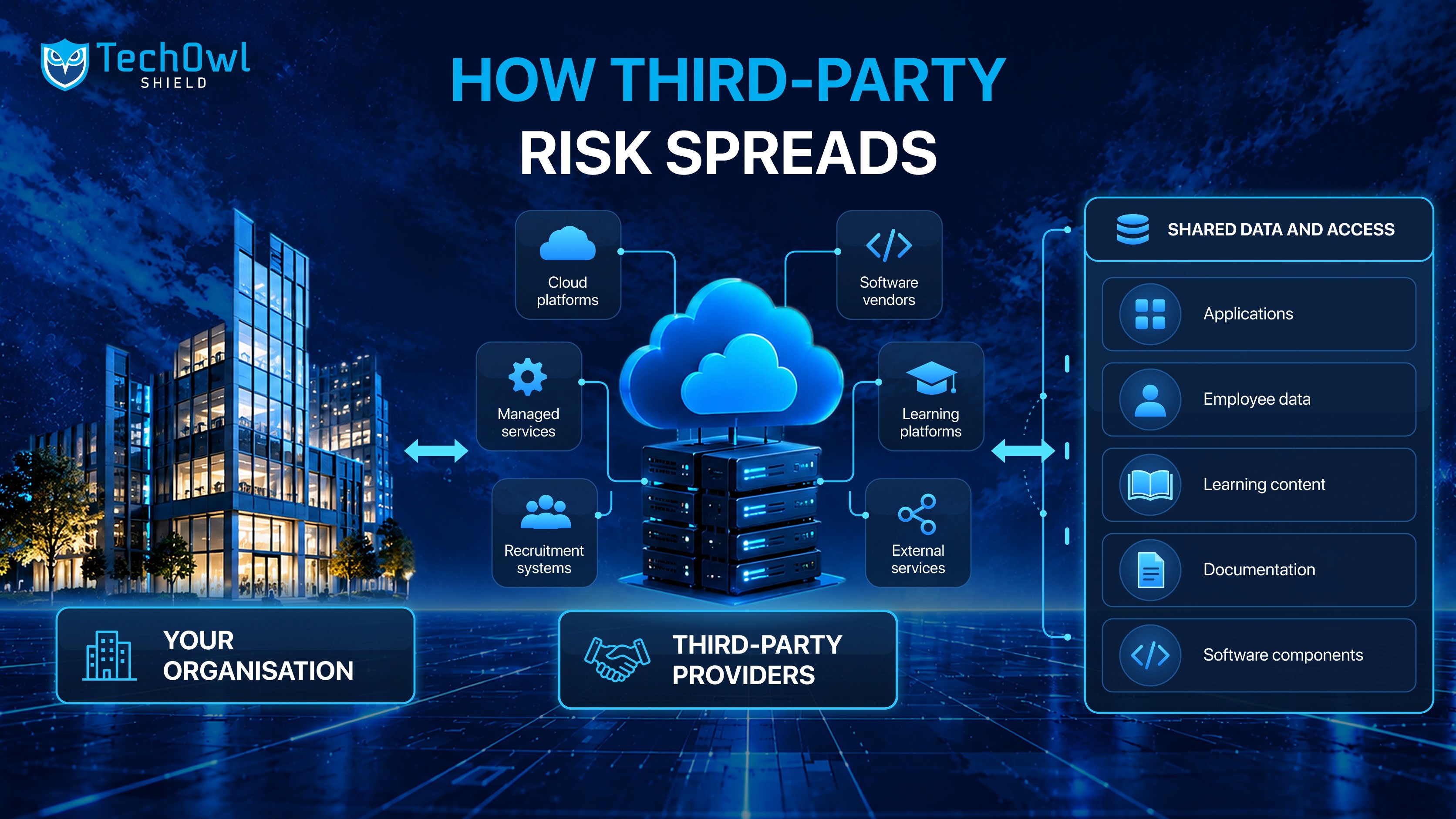
Modern organisations rarely operate entirely within their own technology environments. They rely on cloud platforms, managed service providers, software vendors, recruitment systems, learning management platforms and other external services.
These providers may store organisational information, process employee records, maintain application components or exchange data with internal systems. Each relationship creates a dependency that needs to be understood and managed.
In the PwC incident, the reported service was used to host employee learning records. Depending on how such platforms are configured, learning environments may contain personal details, employment information, course histories and administrative documentation.
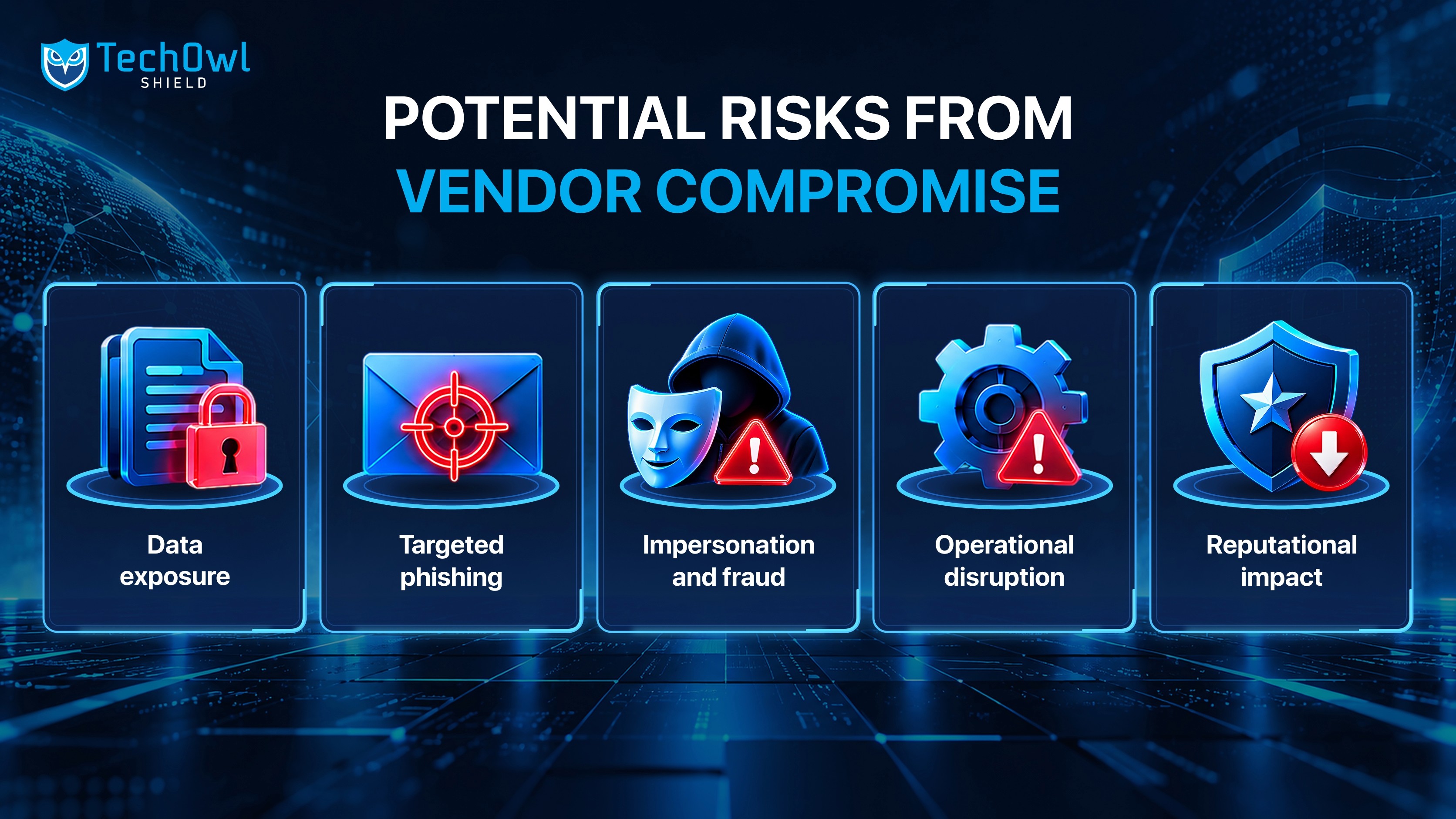
Even where a platform does not contain client financial records, the information it holds may still be useful for impersonation, targeted phishing or social engineering. The level of exposure depends on the actual information involved and whether it was accessed or disclosed.
The central issue is not that every third-party provider is inherently unsafe. It is that an organisation's security posture partly depends on the controls implemented by the providers it trusts.
A business may have strong internal security policies but still face exposure if a vendor has weak access controls, inadequate monitoring, insecure software or insufficient incident response procedures.
This is why third-party risk should be considered part of enterprise cybersecurity governance rather than a separate procurement responsibility.
How a Third-Party Data Breach Can Affect an Organisation
A third-party data breach occurs when information held, processed or managed by an external provider is accessed, exposed, altered or stolen without appropriate authorisation.
The consequences depend on the information involved, the provider's relationship with the organisation and the level of connectivity between the vendor's environment and internal systems.
1. Exposure of employee and organisational information
Employee learning records may appear less sensitive than financial databases or customer records. However, their significance depends on their actual contents and how the information could be misused.
Names, work email addresses, job roles and training histories can help attackers construct convincing communications. If attackers obtain accurate information about employees, they may use it to make fraudulent messages appear legitimate.
For example, a message referencing a specific training course or certification requirement could appear credible to an employee who regularly uses an external learning platform. This is a potential abuse scenario, not a confirmed consequence of the PwC incident.
Organisations should therefore assess employee information according to its sensitivity, potential misuse and exposure pathways rather than assuming that non-customer records have little security value.
2. Exposure of technical documentation
Vendor environments may also hold integration documentation, configuration details, software components or records describing how different systems communicate.
If such material is exposed, it could provide attackers with information about application dependencies, authentication processes or system relationships. Whether this creates a practical security risk depends on the contents, architecture and other controls in place.
Technical documentation does not automatically provide access to a system. However, organisations should determine whether exposed materials contain secrets, sensitive configuration details or information that could support further attacks.
3. Reputational and operational consequences
A vendor incident can generate questions about how an organisation selected the provider, what data it shared and how effectively it monitored the relationship.
Even when a company's core network remains unaffected, it may need to investigate the incident, communicate with employees, review contractual obligations and assess potential regulatory implications.
These activities require coordination across security, legal, privacy, procurement, human resources and business leadership teams.
The PwC incident illustrates a broader principle: third-party exposure must be evaluated in terms of data sensitivity, system connectivity, business dependency and potential downstream consequences.
Supply Chain Cybersecurity: Understanding the Wider Exposure
Supply chain cybersecurity focuses on protecting the interconnected network of organisations, products, services and technology components that support business operations.
A digital supply chain may include direct vendors, subcontractors, cloud infrastructure providers, software developers, managed security providers and external platforms used by employees.
An organisation may have a direct contract with one provider while that provider relies on other companies to deliver its services. This creates a layered environment in which security responsibilities and visibility can become complicated.
For example, a company may use an external learning platform hosted by a software provider that relies on a separate cloud infrastructure provider. Each party may operate different controls, maintain different logs and follow different incident response procedures.
If a security incident occurs within one layer, the customer may need information from several organisations to understand the impact.
Effective supply chain cybersecurity requires businesses to map these dependencies and determine which relationships create meaningful exposure.
Key areas to examine
-
Data flows: Identify what information moves between the organisation and each provider, where it is stored and which parties can access it.
-
System integrations: Document connections between vendor platforms, corporate identity services, internal applications and other systems.
-
Subcontractor dependencies: Determine whether providers use additional third parties to store or process organisational information.
-
Security responsibilities: Establish which party is responsible for access management, monitoring, vulnerability remediation, backups and incident notification.
-
Business continuity: Assess how the organisation would continue essential activities if a vendor became unavailable or its environment needed to be isolated.
These activities help organisations understand how a problem in one part of the supply chain could affect other systems or business processes.
The objective is not to eliminate every external dependency. It is to establish visibility, assign accountability and apply controls proportionate to the risks created by each relationship.
Vendor Risk Management in Cybersecurity: Moving Beyond Initial Approval
Vendor risk management in cybersecurity is the ongoing process of identifying, evaluating, monitoring and addressing security risks associated with external providers.
A common weakness in vendor governance is treating security assessment as a one-time procurement exercise. A provider may complete a questionnaire or submit a certification before a contract is signed, but its environment, software, personnel and subcontractors can change throughout the relationship.
A vendor that was considered acceptable at onboarding may later introduce new integrations, change hosting arrangements or experience a security incident.
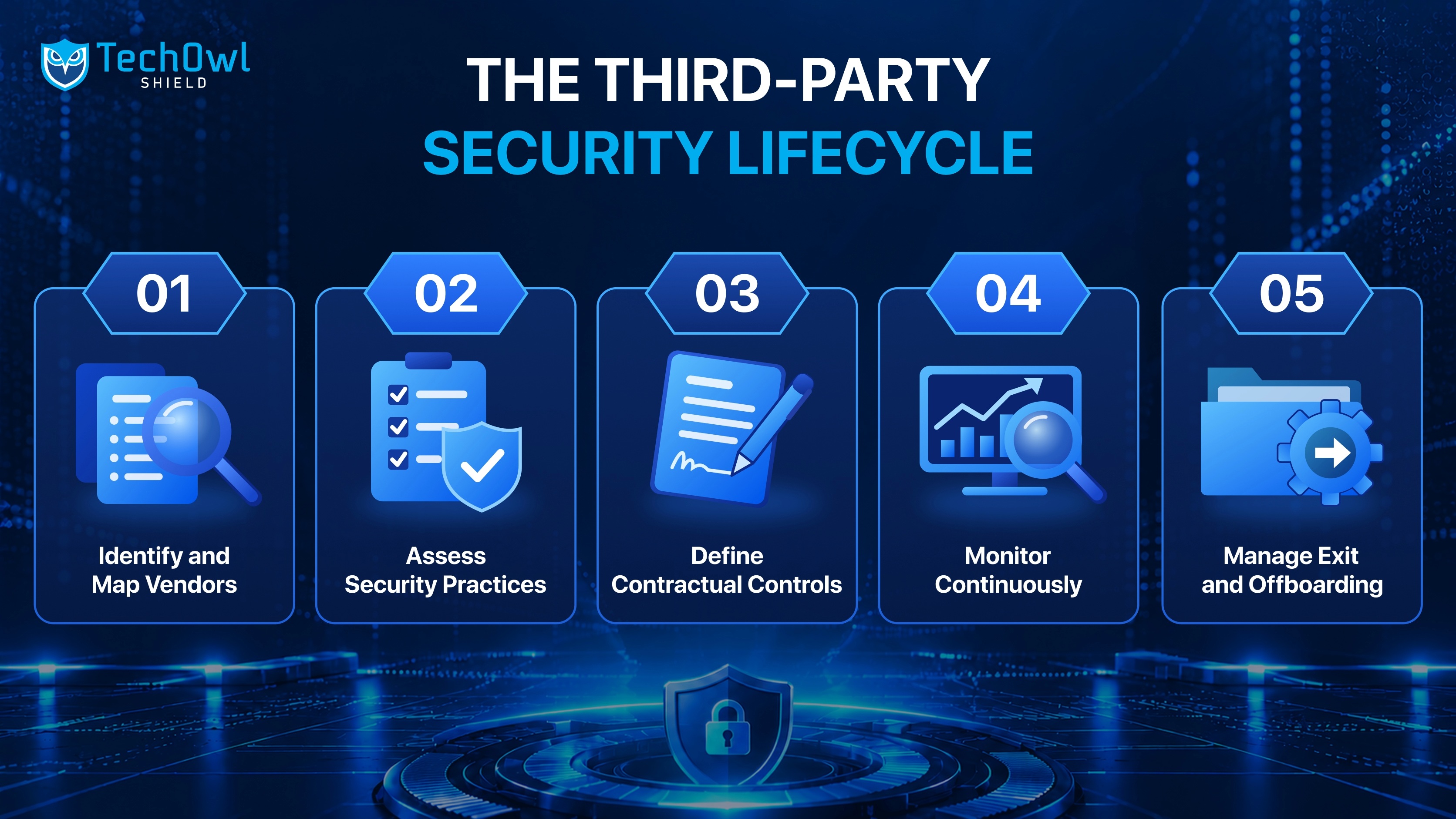
A stronger approach treats vendor risk management as a lifecycle.
Stage 1: Identify and classify vendors
Maintain an inventory of third-party providers and classify them according to the services they deliver, the information they handle and their level of access.
A provider that stores employee learning records may require different controls from one that processes customer payments or administers privileged access to production infrastructure.
Classification should reflect actual exposure rather than the vendor's size or brand reputation alone.
Stage 2: Evaluate security before engagement
Before sharing data or enabling system access, assess the provider's security practices.
Depending on the service, relevant areas may include identity management, encryption, vulnerability management, logging, incident response, business continuity and data deletion procedures.
Organisations should request evidence proportionate to the risk. This may include security policies, independent assessment reports, relevant certifications, penetration-testing summaries and details of incident notification processes.
Documentation should support the assessment, not replace it.
Stage 3: Establish contractual security requirements
Contracts should define security expectations and responsibilities clearly.
Relevant provisions may cover permitted data use, access restrictions, security incident notification, cooperation during investigations, subcontractor management, retention periods and secure data deletion when the relationship ends.
Where appropriate, contracts should also specify audit rights, evidence requirements and expectations for remediation of significant security weaknesses.
The exact requirements depend on the service, applicable laws and the organisation's risk profile.
Stage 4: Monitor the relationship continuously
Vendor assessments should be revisited when significant changes occur, such as new integrations, changes in data processing, major incidents or changes to the provider's security arrangements.
Higher-risk providers may require more frequent reviews and stronger evidence of control effectiveness.
Monitoring can include reassessing access permissions, reviewing security reports, tracking remediation commitments and evaluating changes to the vendor's external exposure.
Stage 5: Manage exit and termination
When a service is discontinued, organisations should ensure that vendor access is revoked and that data is returned, retained or deleted according to contractual and legal requirements.
The exit process should also address API keys, service accounts, certificates, shared credentials and integrations that are no longer required.
A vendor relationship should not remain a source of access after the business need has ended.
For organisations managing large vendor portfolios, TechOwl TPRM provides a way to structure vendor assessments, evaluate responses, document risk findings and monitor remediation. This type of workflow can support ongoing oversight, provided it is integrated into the organisation's broader governance and decision-making processes.
Third-Party Risk Assessment: What Organisations Should Evaluate
A third-party risk assessment helps an organisation understand the security exposure associated with a specific provider and determine which controls are necessary.
The assessment should consider both the provider's security capabilities and the nature of the relationship.
A provider that stores limited, non-sensitive information and has no connection to internal systems may present a different level of risk from one that processes regulated data or holds privileged access.
The following areas form a practical assessment framework.
Data classification and handling
Determine what data the provider receives, stores, processes and shares. Assess its sensitivity, retention requirements and potential consequences if exposed.
Verify whether the provider uses the data only for authorised purposes and whether it can demonstrate appropriate deletion or return procedures.
Identity and access controls
Review how the provider authenticates users, assigns permissions and manages privileged accounts.
Where supported, assess multi-factor authentication, role-based access controls, periodic access reviews and controls for service accounts.
Determine whether vendor personnel receive only the access required for their responsibilities.
Infrastructure and application security
Evaluate how the provider manages vulnerabilities, configuration changes, software updates and security testing.
Where relevant, review the security of web applications, APIs, cloud configurations and external-facing services.
Independent evidence and properly scoped testing can help identify weaknesses that policy documents alone may not reveal.
Monitoring and incident response
Determine whether the provider records relevant security events, investigates suspicious activity and maintains a documented incident response process.
Review how the provider notifies customers, preserves evidence and supports investigations when an incident affects shared data or systems.
Resilience and recovery
Assess whether the provider has tested backup, restoration and continuity arrangements appropriate to the service.
Consider the consequences if the platform becomes unavailable or needs to be isolated during an investigation.
Subcontractor management
Establish whether the provider uses subcontractors that can access or process organisational data.
Review how security requirements flow through the subcontracting chain and how the primary provider maintains visibility into those relationships.
Risk ownership and remediation
Each identified risk should have an owner, a remediation plan and a target date where appropriate.
Organisations should record whether a risk has been addressed, accepted through an authorised process or requires further investigation.
A third-party risk assessment is useful only when its findings inform actual decisions. Completing a questionnaire without addressing material weaknesses provides limited assurance.
For organisations seeking to connect vendor assessments with documented control requirements, Complython supports compliance workflows, risk tracking and evidence management. These capabilities can complement vendor governance, while the assessment itself must remain tailored to each provider's actual exposure.
Data Security in Third-Party Systems
Data security in third-party systems requires organisations to understand how information is protected throughout its lifecycle, from collection and transfer to storage, access, retention and deletion.
The first step is data minimisation. Providers should receive only the information necessary to deliver the contracted service. Unnecessary data sharing increases the amount of information exposed if the provider experiences an incident.
Encryption is another important control. Data should be protected in transit and, where appropriate, at rest. Organisations should also understand who manages the relevant encryption keys and how access to them is restricted.
Access controls must be aligned with the data's sensitivity. Administrative permissions should be limited, reviewed periodically and removed when no longer needed. Where integrations are involved, service identities and credentials should be managed securely.
Logging and auditability are equally important. Organisations should establish which events the provider records, how long logs are retained and whether relevant evidence can be accessed during an investigation.
Finally, data retention and deletion requirements should be explicit. Organisations should know when records will be removed, how deletion is verified and whether copies remain in backups or subcontractor environments.
These controls should be supported by clear contractual terms and periodic reviews. Responsibility for protecting information cannot be managed effectively if the organisation does not understand where the information resides or how the provider handles it.
Third-Party Access Control: Limiting the Impact of Compromise
Third-party access control determines how external users, systems and service providers connect to an organisation's environment and what actions they are permitted to perform.
Poorly managed vendor access can increase exposure because external accounts may remain active beyond their intended purpose or retain permissions that are no longer necessary.
A risk-based access model should apply several principles.
-
Least privilege: Give each external identity only the permissions required to perform its authorised tasks.
-
Strong authentication: Use multi-factor authentication for vendor access where supported, particularly for administrative or sensitive operations.
-
Separate identities: Avoid shared accounts wherever possible. Individual identities improve accountability and help investigations establish which account performed an action.
-
Time-bound access: Grant access for a defined period when practical, especially for maintenance, support and temporary projects.
-
Privileged access management: Apply additional controls to accounts capable of changing configurations, accessing sensitive information or administering critical systems.
-
Regular access reviews: Confirm that vendor personnel, service accounts and integrations still require their current permissions.
-
Prompt revocation: Remove access when contracts end, personnel change roles or a security concern requires immediate restriction.
-
Monitoring: Record and investigate unusual vendor login activity, unexpected privilege changes and access outside approved patterns.
Organisations should also review trust relationships between connected environments. A vendor's account should not automatically provide broad access to unrelated systems simply because the provider is trusted for one specific service.
The appropriate controls depend on the architecture and business requirement, but the guiding principle is consistent: vendor access should be limited, visible, reviewable and revocable.
Cybersecurity Incident Response When a Vendor Is Compromised
Cybersecurity incident response should account for incidents originating within external providers, not just those detected on an organisation's own network.
A vendor incident may require coordinated investigation even when there is no evidence that the customer's primary environment has been compromised.
An effective response begins with establishing the facts.
Step 1: Confirm the scope of the incident
Determine which vendor service or environment is involved, what data it processes and whether the provider has identified unauthorised access or data exposure.
Separate confirmed findings from preliminary reports and threat actor claims. Avoid making assumptions about the scale or consequences of the incident before sufficient evidence is available.
Step 2: Contain relevant exposure
Depending on the circumstances, containment may involve disabling affected integrations, revoking credentials, restricting vendor access or isolating a compromised service.
Containment decisions should consider the risk of further exposure alongside the operational impact of interrupting the service.
Step 3: Preserve evidence
Coordinate with the vendor to preserve relevant logs, access records, configuration changes and other technical evidence.
Document the timeline, actions taken and decisions made. Evidence should be protected against unauthorised alteration and made available to authorised investigators.
Step 4: Assess data and system impact
Identify the types of information involved, the relevant systems and the potential consequences for employees, customers and business operations.
Review whether the vendor environment had connections to internal applications, identity systems or other providers. The objective is to determine the actual scope of exposure rather than assume that every connected system was compromised.
Step 5: Coordinate communications and obligations
Involve security, legal, privacy, procurement and relevant business teams. Assess contractual notification requirements and applicable regulatory or legal obligations.
Communications should be accurate, appropriately timed and based on verified information. Where facts remain uncertain, that uncertainty should be stated clearly.
Step 6: Recover and validate
Before restoring access or normal operations, verify that relevant security weaknesses have been addressed and that required controls are functioning.
Recovery may include rotating credentials, rebuilding affected components, reviewing access permissions and increasing monitoring.
Step 7: Review and improve
After the incident, assess whether vendor selection, access management, monitoring, contractual provisions or response procedures need improvement.
Update the vendor's risk classification and reassess the relationship based on the investigation's findings.
A documented incident response framework can help organisations establish response roles, containment procedures, forensic investigation steps and post-incident validation. The specific response must still be adapted to the systems involved and coordinated with the affected provider.
How Security Monitoring and External Exposure Management Can Help
Third-party cybersecurity risk cannot be managed through procurement questionnaires alone. Organisations also need technical visibility into exposed assets, suspicious activity and weaknesses that may affect connected environments.
Security monitoring can help identify unusual authentication activity, unexpected privilege changes and suspicious behaviour across systems for which relevant telemetry is available.
A Managed SOC can support continuous monitoring, alert investigation and incident escalation. Its effectiveness depends on log availability, system integrations, detection rules and clearly defined response responsibilities.
External Attack Surface Management can help organisations discover internet-facing assets, including websites, applications, APIs and cloud services, and identify potential exposures that require assessment. TechOwl Shield supports external attack surface visibility alongside dark web and brand monitoring, which can contribute to a broader exposure management programme.
Vulnerability Assessment and Penetration Testing (VAPT) can help evaluate weaknesses in applications, infrastructure and configurations within an authorised scope. Findings should be prioritised, remediated and retested as appropriate.
These capabilities address different parts of the security lifecycle. Monitoring does not replace access control, external asset discovery does not prove that an asset is compromised, and VAPT does not guarantee that future incidents will not occur.
For organisations reviewing their third-party exposure, the priority should be to combine technical visibility with effective vendor governance, secure integrations and tested incident response procedures.
Practical Checklist for Managing Third-Party Cybersecurity Risk
Organisations can use the following checklist to review the maturity of their vendor security programme.
-
Maintain an inventory of vendors that access, store or process organisational data.
-
Classify vendors according to data sensitivity, business criticality and system access.
-
Conduct a documented third-party risk assessment before onboarding high-risk providers.
-
Verify relevant security controls using appropriate evidence.
-
Define contractual requirements for security, incident notification and data handling.
-
Maintain an accurate record of vendor integrations and data flows.
-
Enforce least-privilege access and review vendor permissions regularly.
-
Apply multi-factor authentication where supported and appropriate.
-
Protect service accounts, API credentials and other integration secrets.
-
Confirm that relevant security events are logged and can support investigations.
-
Review the provider's incident response and business continuity arrangements.
-
Track security findings through remediation and verification.
-
Reassess vendors following major changes or significant incidents.
-
Revoke access and verify data handling when a vendor relationship ends.
-
Test internal procedures for responding to a third-party data breach.
This checklist should be tailored to the organisation's risk profile, contractual commitments and applicable legal requirements. A small provider handling limited information may not require the same assessment depth as a critical provider with privileged access or extensive data-processing responsibilities.
The goal is proportionate oversight, supported by evidence and clear accountability.
Conclusion: Third-Party Security Must Be Part of Enterprise Cybersecurity
The PwC cybersecurity incident reported in October 2026 highlights the importance of understanding and managing third-party cybersecurity risk across interconnected business environments.
PwC confirmed an incident involving a third-party vendor site used to host employee learning records and stated that the incident did not affect its network or operations. However, the Everest group's claim that it had stolen 590 GB of data was not confirmed by PwC in the Reuters report. The vendor's identity, the technical cause and the full extent of the incident were not established in the information reviewed.
These distinctions are essential to a responsible incident analysis. They also reinforce the need for organisations to maintain visibility into the providers that handle their information and support their operations.
Effective third-party security requires more than selecting a provider with a credible reputation. It involves assessing vendor controls, limiting access, protecting data, monitoring relevant activity and maintaining a coordinated incident response process.
Organisations should treat external providers as part of their broader security ecosystem and ensure that risks are assessed throughout the relationship, from onboarding to termination.
As supply chains become more connected, third-party cybersecurity risk should be managed as an ongoing business and security responsibility, supported by clear governance and technical controls.
Frequently Asked Questions (FAQs)
1. What happened in the PwC cybersecurity incident?
According to Reuters, PwC confirmed on 23 October 2026 that it was aware of a cybersecurity incident involving a third-party vendor used to host employee learning records. The confirmation followed an Everest group claim that it had stolen 590 GB of data. PwC did not confirm the alleged volume or contents of the data.
2. What is third-party cybersecurity risk?
Third-party cybersecurity risk is the potential for an organisation to experience data exposure, unauthorised access or operational disruption because of a security issue involving an external provider, supplier or service partner.
3. Was PwC's main network compromised?
PwC stated that the incident did not affect its network or operations. The Reuters report did not establish that PwC's primary network had been compromised.
4. Why is a third-party data breach a concern if client data is not involved?
Employee records, organisational information and technical documentation may still create privacy, impersonation, social engineering or security risks, depending on their contents and exposure. Organisations should assess data according to its actual sensitivity and potential misuse.
5. How often should organisations conduct a third-party risk assessment?
The frequency should reflect the provider's risk level, data access and business criticality. Assessments should also be revisited when significant changes occur, such as new integrations, changes in data processing or a major security incident.
6. How should organisations respond to a third-party cybersecurity incident?
They should establish the scope, contain relevant exposure, preserve evidence, assess data and system impact, coordinate communications, meet applicable obligations and validate recovery. They should also review vendor controls and address weaknesses identified during the investigation.
Sources
-
Reuters: PwC confirms cybersecurity incident involving employee learning records
-
Cybersecurity Dive: PwC learning records affected by incident at vendor site
Related TechOwl Resources