
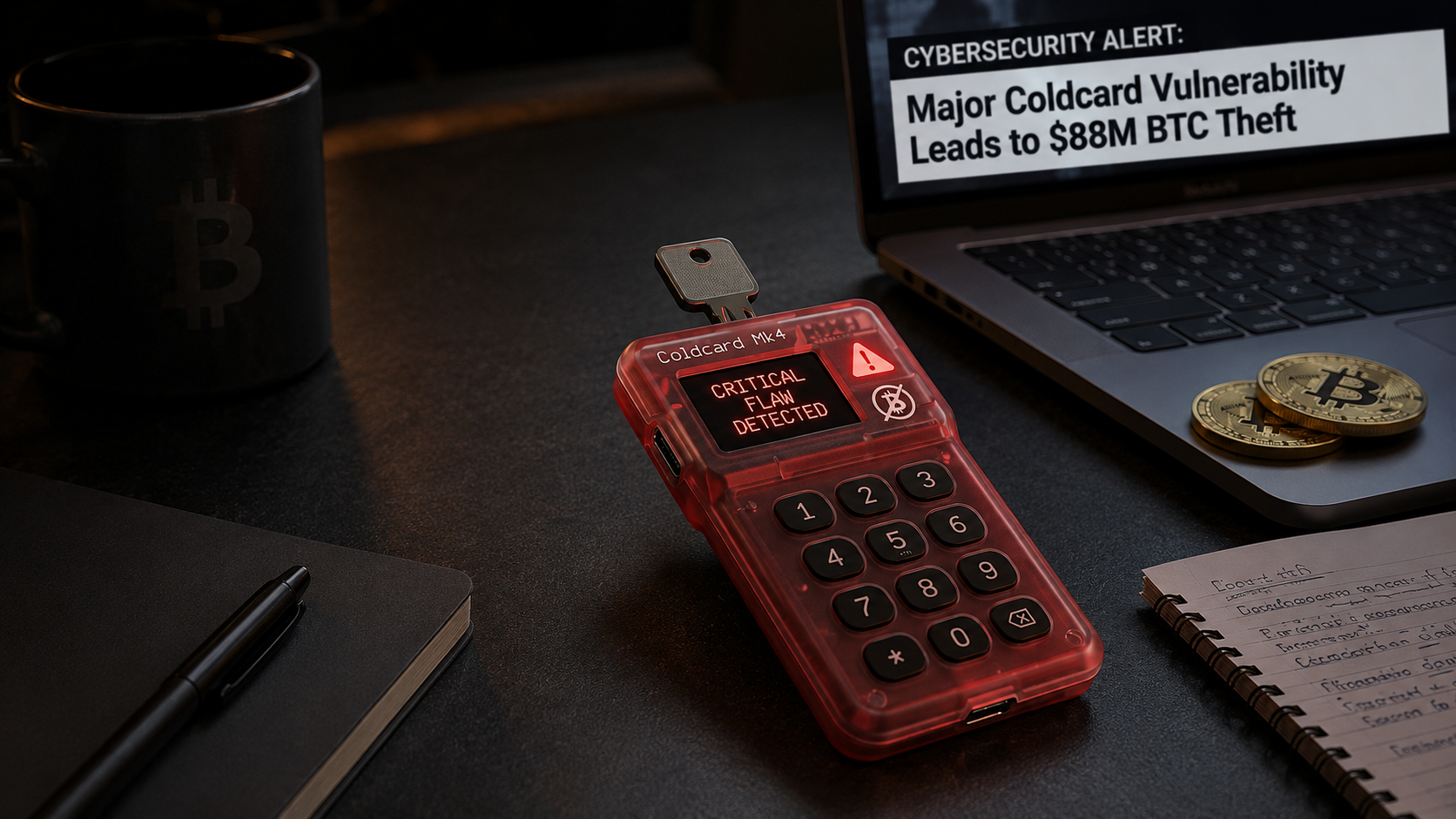
What happened
On 30 July 2026, someone emptied 4,585 Bitcoin wallets in a matter of minutes, taking around $88 million. Nobody was hacked in the way most people picture it. No one was tricked into clicking a link, no password was stolen, and no device was ever touched or even switched on.
The wallets were COLDCARD devices — small physical gadgets designed to hold Bitcoin safely, deliberately kept offline and away from the internet. They are the sort of thing careful people buy precisely so this cannot happen.
The problem was that these devices had been generating predictable secrets since March 2021, and nobody noticed for five years.
Imagine a factory that makes very good safes. The steel is thick, the lock is excellent, the hinges are tamper-proof. Every safe is genuinely well built.
But the machine that chooses the combination numbers is broken. Instead of picking randomly, it picks from a short list — and it always starts from the same place. The safes are still strong. It is just that the combinations are guessable.
Someone eventually worked out the pattern, wrote down every combination the machine could ever produce, and went to try them. That is this incident. The safe was never broken into — the combination was simply worked out in advance.
Why nobody spotted it for five years
When your wallet creates your secret recovery phrase, it is supposed to pick those words using genuine, unpredictable randomness — the equivalent of rolling dice thousands of times. The device has dedicated hardware on board to do exactly this, and it works properly.
Because of a single line written incorrectly in the software, the wallet stopped asking that hardware for its randomness. It quietly used a simple mathematical formula instead — one that produces numbers that look random but can be worked out by anyone who knows the formula.
Nothing looked wrong. The recovery words the device displayed appeared completely normal. Backups worked. Restoring worked. Every check the device performs passed. There was no warning, no error and no way for an owner to tell.
This is what makes randomness failures so dangerous: predictable numbers and genuinely random numbers look identical. The only difference is whether a stranger can work them out — and there is no way to see that by looking.
How the theft worked
Because the formula was predictable, the attacker could do the entire job on their own computer, in private, without ever going near anyone's wallet:
- Work out every recovery phrase the broken formula could possibly have produced.
- Calculate which Bitcoin address each one would correspond to.
- Check those addresses against the public Bitcoin record, which anyone can read, to see which ones hold money.
- Take the money from the ones that do.
The last step is the first moment anything is visible to anyone. Everything before it happened silently on a stranger's computer. There was no alert to miss, no suspicious login to notice and no mistake any owner made.
The attacker went after the biggest balances first. Around $30 million was gone in the opening ten minutes.
Are you affected?
This applies to you if you own a COLDCARD wallet. If you use a different brand, or keep your Bitcoin on an exchange, this particular problem does not affect you.
You rolled dice to create your wallet. The device offers an option to generate your words from at least 50 dice rolls. The randomness then comes from your hand, not from the faulty software. If you did this, you are not affected.
You added a strong, unique extra passphrase. This puts your wallet outside anything the attacker can work out — as long as the passphrase is genuinely hard to guess and you have not used it anywhere else.
Your recovery words came from somewhere else. If you created them on a different device and typed them into the COLDCARD, they never went through the faulty part.
What to do
Updating your device does not fix a wallet you already have. The update stops the problem happening again in future, but your existing recovery words were already created badly and cannot be repaired. Moving them to a different wallet or a different brand of device does not help either — the words themselves are the problem. You need new words, and your money needs to move to them.
Do not delay this. The thefts are still happening as of today — four separate waves have been recorded since 30 July. Money sitting in an affected wallet is not safe simply because it has not been taken yet. It is only further down the list.
Why this matters beyond Bitcoin
The uncomfortable lesson is that everything else about these devices worked perfectly. The tamper protection, the offline design, the security chips — none of it was defeated, and none of it mattered. All of it exists to protect a secret after that secret has been created. When the secret was guessable from the very beginning, everything built on top of it protected nothing.
It is also worth noting how ordinary the mistake was. This was not a sophisticated attack or a hidden backdoor. The manufacturer had even written a safety check specifically designed to catch this exact situation — and the check itself contained a small error, so it never triggered. Good intentions and careful engineering were not enough, because nothing in normal testing can tell the difference between real randomness and a convincing imitation.
Generating your own randomness. Everyone who used the dice option was untouched by this. It takes about ten minutes and was widely considered unnecessary caution before last week.
Spreading trust across brands. For larger amounts, wallets can be set up to require approval from several devices made by different manufacturers. One company's mistake then cannot cost you everything on its own.


